



Nation's space achievements out of this world









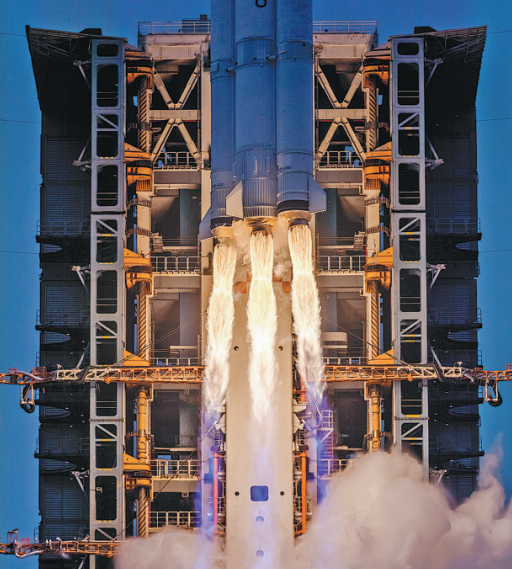
Touchdown
On Dec 1, the lander-ascender touched down on the moon, becoming only the third spacecraft to reach the lunar surface since the mid-1970s, following Chang'e 3 and Chang'e 4.
Shortly after landing, the craft began drilling for samples 2 meters below the surface and using a mechanical arm to scoop up soil.
The collection operation finished after about 19 hours, on Dec 2, much earlier than expected. The samples were packed into a specially designed vacuum container inside the ascender to avoid contamination.
During the process, the lander unfurled the first free-standing Chinese national flag on the lunar surface, making China the second nation to place such an emblem on the moon after the US.
On Dec 3, the ascender lifted itself into an elliptical lunar orbit to dock with the reentry capsule, thus marking the first time a Chinese spacecraft had blasted off from an extraterrestrial body. It linked up with the orbiter-reentry capsule combination on Dec 6 and transferred the lunar samples.
The ascender separated from the orbiter-reentry combination later that day and was deliberately crashed into the moon on Dec 8 to prevent it becoming space debris.
The combination made several preparatory maneuvers during lunar orbit and entered a moon-Earth transfer trajectory on Dec 13 to begin its flight back to Earth.
Early on Dec 17, the reentry capsule separated from the orbiter about 5,000 kilometers above the southern Atlantic Ocean and began its descent.
It touched down at a preset landing site in Siziwang Banner, Inner Mongolia autonomous region, at 1:59 am, ending a mission that had been closely followed by scientific communities and media around the globe.
The sealed samples were transferred to a specially designed laboratory at the Chinese Academy of Sciences and will later be distributed to researchers for analysis, experiments and tests.
"Research on lunar samples is one of the most important ways we can learn about the past, present and future of the moon, and also provides great help when scientists investigate the evolution of other members of our solar system," said Guo Hongfeng, a National Astronomical Observatories researcher.
Some of the samples will be put on display to boost scientific awareness, especially among the younger generation.
"This will greatly encourage people, especially young people, to study and explore the worlds beyond Earth," Xiao Long, a planetary geologist at the China University of Geosciences in Wuhan, Hubei province, told Nature magazine.
Officials at the China National Space Administration have welcomed cooperation from foreign scientists in researching the samples.


- Scoop up yuanxiao to uncover Hefei's charm
- China's CPPCC session to open Wednesday
- Shanghai Cherry Blossom Festival 2026 to illuminate Gucun Park with nighttime blossoms
- China lauded for role in global poverty reduction
- Jiangsu awash in Lantern Festival joy
- Shehuo celebration kicks off Lantern Festival in Changji, Xinjiang





