


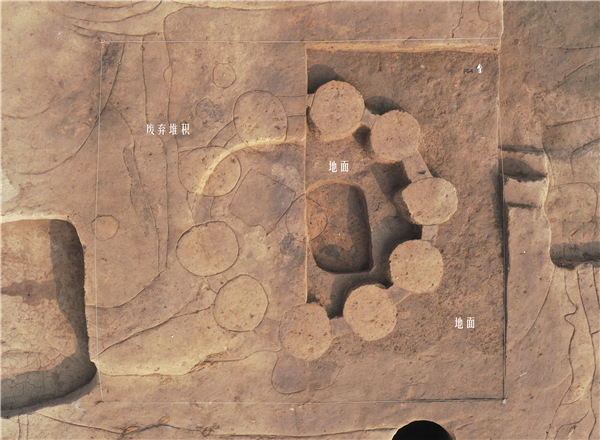
The past 20 years have witnessed a long list of key discoveries in Erlitou, like the remains of palaces, altars, nobles' tombs and ceremonial artifacts like a dragon-shaped decorative object made of more than 2,000 pieces of turquoise.
"All of these have shown that Erlitou was a political, economic and cultural hub, indicating kingship," Zhao says.
"And the new evidence of the city's layout further displays a highly developed civilization, matching the sophistication of the Xia Dynasty in history. The site is a pivotal reference to know how an early-stage state was formed in China."
However, only 45,000 square meters, or 1.5 percent of the total area, of the Erlitou site have been excavated so far.
For Zhao's team, much remains unknown. For example, the city's outer wall and the royal family's graves were not found in Erlitou. Erosion from the nearby Luohe River may have also permanently erased key clues.
"Whether they exist or not, people deserve to know," Zhao says.
"And if Erlitou was the capital, how did it control a country with a vast territory? So much research needs to be done."
Song Xinchao, deputy director of the National Cultural Heritage Administration, says: "If we only look at Erlitou, we cannot really understand its features. It has to be compared with other sites from its time to draw a bigger picture."
In August, the cultural heritage administration announced that a five-year national research program exploring Xia culture had been launched. It involves not only Erlitou but also other sites in such provinces as Henan, Hebei, Anhui, Shandong and Shanxi.
Fruitful discoveries have burgeoned this year.
For example, legends surrounding Yu the Great, the ruler who founded the Xia Dynasty according to historical records, may not only be stories handed down through word of mouth.
In Shiji, the ruler is recorded to have met other tribal leaders in Tushan. He married a local woman and thus formed a powerful alliance. Although a village in Bengbu, Anhui province, was speculated to have been the location of their meeting, and the name of the village, Yuhui ("meeting of Yu"), also lent credibility to the story, the account had for long seemed scantly supported by strong evidence.
However, the 180,000-square-meter city ruins in the village that date back 4,100 to 4,400 years, which were excavated this year, may create more room for imagination.
Zhang Dong, the program's leading archaeologist, unveiled the discovery of a 300-meter-long section of the northern wall and a 600-meter-long stretch of the eastern wall.
Rich discoveries of human settlements and possible remains of drainage systems were found, making it the largest city ruins from that time to be found along the middle reaches of the Huaihe River.
"Although the dating of the site does not perfectly match with Xia chronologies, we found it was a booming settlement during its time," Zhang says.
"The discovery shows that Yu's meeting may have actually happened, but things can only become clearer through our subsequent work."





