



Shared ambitions









China and US can work together to revive multilateralism with a global pact for a climate-friendly global recovery
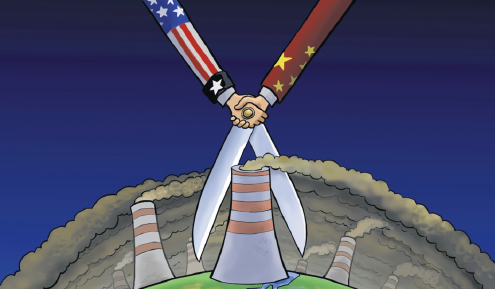
The past four years have been marked by rising tensions between the United States and China, but the world's two largest economies will continue to have a number of shared interests bringing them together even as they disagree on other matters. Key among those shared interests are a stable world economy and a stable global climate.
Both countries should agree to lead by example, mounting green and inclusive recovery strategies from the pandemic domestically, and then work together to revive multilateralism with a global pact for a climate-friendly global recovery.
During the global financial crisis in 2008-09, both China and the US put in place ambitious monetary and fiscal stimulus packages to inject growth into their economies.
The two countries played a key role in restarting international trade after the crisis, backed a new allocation of the International Monetary Fund's Special Drawing Rights basket to provide liquidity to the world's poorest countries and agreed to increase the IMF's firepower through a new quota increase.
Building on that successful cooperation, the two countries entered into the US-China climate change agreement, enabling the 2015 Paris Climate agreement that puts the global economy on the path of stabilizing global carbon emissions.
The world is now faced with a crisis that is worse than in 2009, and one that threatens to derail our climate and development goals. The pandemic has brought economic activity to a halt, triggering one of the biggest economic contractions ever.
In April, the IMF thought that emerging markets and developing economies might contract by around 2.3 percent; they now see a contraction of 5.7 percent. The World Bank estimates that more than 150 million people will be pushed into extreme poverty by 2021. This year has also been the second warmest year on record, triggering hurricanes, forest fires and droughts that have ravaged economies and livelihoods already struggling because of the pandemic. All these forces are leading to a global debt crisis that could derail efforts toward sustainable development and climate change for decades.
Importantly, China has led by example, swiftly getting control of the virus, mounting a large stimulus package and committing to decarbonize its economy by 2060.Globally, China has called for a major new allocation of SDRs so that poorer countries can cope during these hard times. China is also the largest contributor to the Debt Service Suspension Initiative, a G20 initiative to suspend the debt repayments of the poorest countries till mid-2021.
Joe Biden, who is expected to lead a new administration in the US, worked with China between 2009 and 2015. Following China's pledge, Biden has committed to net-zero emissions by 2050 through a bold economic recovery plan based on infrastructure and clean energy. What is more, Biden has said that on taking office he will immediately bring the US back into the Paris Agreement.
With these bold actions in place, both countries will have the moral authority to revive multilateralism with a global pact toward a climate-friendly recovery from the COVID-19 crisis. Such a pact should include four components.
First, the two countries should agree to China's call for a major new allocation of SDRs and expand the core resources of the IMF.
Second, the two countries should advance a global debt relief effort that goes beyond debt suspension and reduce the full value of emerging market and developing country debt. Such debt relief would be required of bilateral, multi-lateral and importantly private creditors.
Third, to mimic the efforts that China and the US would be leading domestically, such a global pact would ask participating countries to also commit to net-zero emissions and to align their newfound fiscal space with the goals of the Paris Climate Agreement.
Fourth, to spur these efforts, China's policy banks should co-finance climate-friendly recovery efforts with their US counterparts and with leading multilateral development banks such as the Asian Infrastructure Investment Bank and the World Bank.
Such an approach is easily within reach and could be a win-win scenario for the world economy and the US-China relationship. Leading by example and reviving multilateralism will help the world build back better from the COVID-19 crisis in a manner aligned with our global development and climate goals. And for the US and China, the more they work together on shared interests, the easier it will be to resolve their differences.
The author is a professor and the director of the Global Development Policy Center at the Pardee School of Global Studies. The author contributed this article to China Watch, a think tank powered by China Daily. The views do not necessarily reflect those of China Daily.
If you have a specific expertise and would like to contribute to China Daily, please contact us at opinion@chinadaily.com.cn, and comment@chinadaily.com.cn.





