Prepare for the worst, scope for the pest









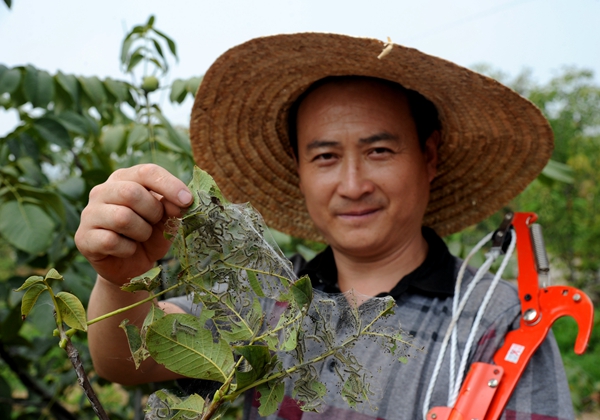
Ragweed invaded China more than 80 years ago and has spread to over 20 provinces and cities. According to a study by Zhang Xiaoli from Beijing Plant Protection Station, among the pollen allergy patients at Peking Union Medical College Hospital between 2016 and 2018, more than one quarter were triggered by ragweed pollen.
Few invasive alien species have arrived naturally. Weeds can spread through airflow, water flow or get carried by migratory birds, insects and animals.
Spodoptera frugiperda, or fall army worm, flew into Southwest China. First detected in Yunnan province in January 2019, the pest had infested over 1 million hectares of land through 2019 and caused an economic loss of 10 billion yuan.
China's Ministry of Agriculture and Rural Affairs warns that the formidable harm caused by fall army worms could erupt in more places in 2020.
The invasion of non-native species is a complicated ecological process including transport, colonization, establishment and landscape spread.
According to Liu, once a new invasive alien species has been found to significantly affect agroforestry production or ecological environment, it means it has taken root and is almost impossible to eliminate.
"The key is to carry out strict and scientific monitoring, prevention and control at early stage of invasion which can minimize the ecological and economical loss the invasive alien species may cause," Liu says.
Liu and his team have studied the tomato leaf miner's distribution history and trend worldwide, especially in Asia, and analyzed the possible ways and areas through which it has invaded China for years.
After continuous fixed-point monitoring in high-risk areas including Yunnan and Xinjiang, they managed to detect the pest at an early stage.
"To monitor and control invasive alien species needs multidisciplinary collaborations including biology, chemistry, agricultural pharmacology and computer science," he says.
Liu says there is need to build a technology platform for precise detection and intelligent remote monitoring-detection methods using technologies including modern molecular biology, satellite remote sensing, DNA fingerprints and unmanned aerial vehicles.
Liu thinks that, as well as using technology, providing more information and knowledge to farmers about potential invasive alien species can help detect them in a timely manner.