



Hydrogen trucks take to Chinese roads for Budweiser










Budweiser, the world's largest brewer, announced in Shanghai on Oct 28 that four hydrogen fuel cell trucks would be put into use to deliver Budweiser beer in Shanghai. China is the first country where the company has deployed fuel cell trucks for beer delivery.
Compared to traditional fossile fuels, Hydrogen is been considered as clean and promising vehicle fuel. Hydrogen fuel cell vehicles, powered by electricity generated by compressed hydrogen fed into fuel cells, has zero greenhouse gas emissions as it produces only water, electricity and heat. However, it still has to overcome several challenges, including cost and infrastructure.
"We can't wait until everything is perfect to try new technologies. And if we want to be a leader, we try new things," said Jan Clysner, vice president for procurement and sustainability at Budweiser APAC. "With technology and infrastructure in China, we are glad to join the effort to drive innovation in green logistics and take the lead at Budweiser globally."
Budweiser announced its 2025 Sustainable Development Goals) in 2018. It aims to reduce carbon dioxide emissions by 25 percent across its full supply chain by 2025 compared to 2018, making the company's goals the most ambitious among beer companies. As part of this overall commitment, China Logistics will reduce its carbon emissions by 40 percent, a reduction of 70,266 tons of carbon emissions.
Over the past years, the company has reduced the carbon footprint of its logistics by increasing the number of green vehicles and electric forklifts, increasing vehicle loading, reducing transport distances and changing transport modes from road transportation to railways in China. To date, it has officially deployed more than 200 green vehicles, including liquid natural gas trucks, electric trucks and the newly deployed hydrogen fuel cell vehicles.
Since 2018, Budweiser has worked with BYD in electric trucks, Feichi in a fuel cell truck deployed in Foshan and now BestPath in fuel cell trucks deployed in Shanghai. Jan said these partners shared the same value and vision for green logistics with the company, and that's why they could work together. "We have even introduced Chinese partners to the US market," he added. Budweiser ordered 21 pure electric trucks from BYD in North America in 2019.
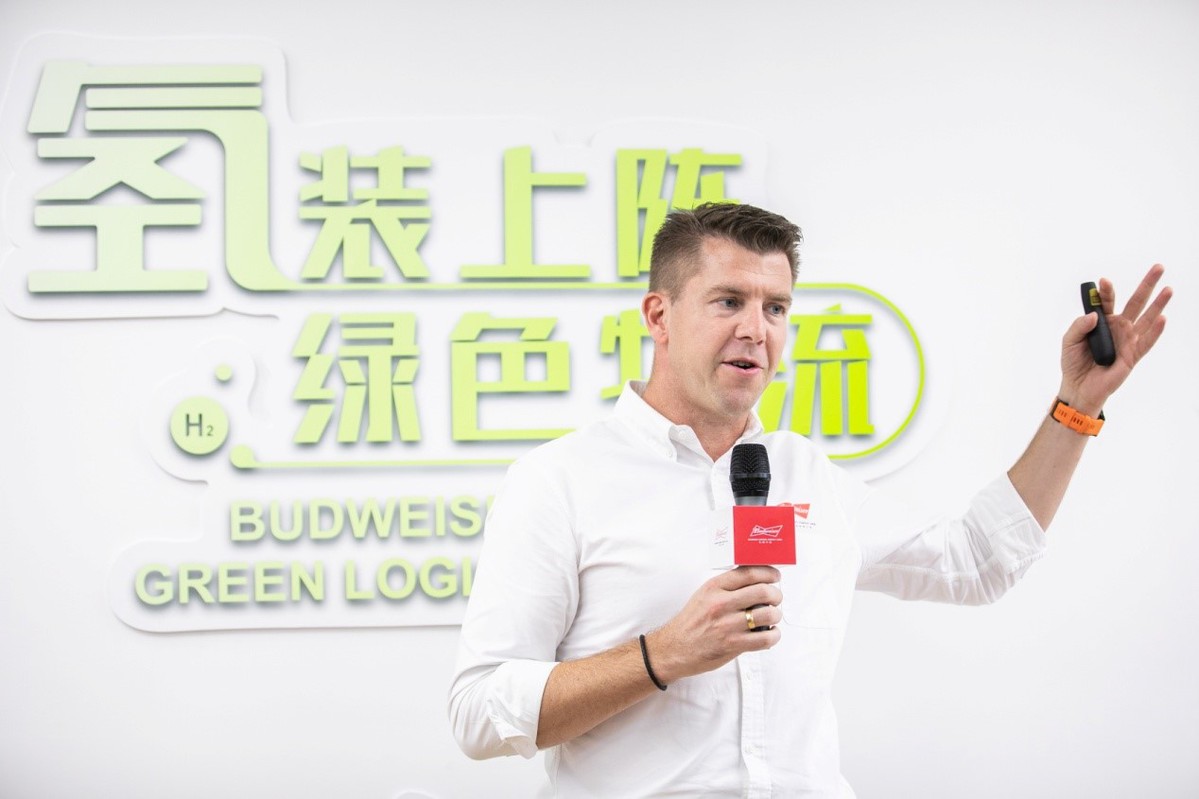
The company looks forward to expanding the scale of its electric and fuel cell truck fleets in China. The choice of location for fuel cell truck deployment is based on the charging station network in China, as well as the country's distribution network. "Thanks to the Shanghai local government, we see promising development of infrastructure here."
Budweiser is also driving green logistics among FMCG companies in China. "One of the benefits is we can share trucks to reduce empty milage." In addition, with more companies adopting new technology vehicles, it will help with the development of infrastructure.
In addition to green logistics, Budweiser is driving sustainability-friendly innovations through its 100+ Accelerator globally and Innovation Hub in China. It is working with start-ups along the value chain of the company. Recent projects include a partnership with Cardinal to develop a platform which makes earlier to build truck pools and reduce empty millage in China, a partnership with Shianco to use rice husks to make floor and furniture and a partnership with YuShuo to use retired batteries from EV trucks to build power storage systems for breweries.
"We help them grow either through a small initial investment or through pilot programs at our breweries. If the pilot is successful, we try to scale in China, and can also take them to other markets, which helps us stay ahead of the competition as well," Jan said.











