



Five-year plan holds promise for Africa









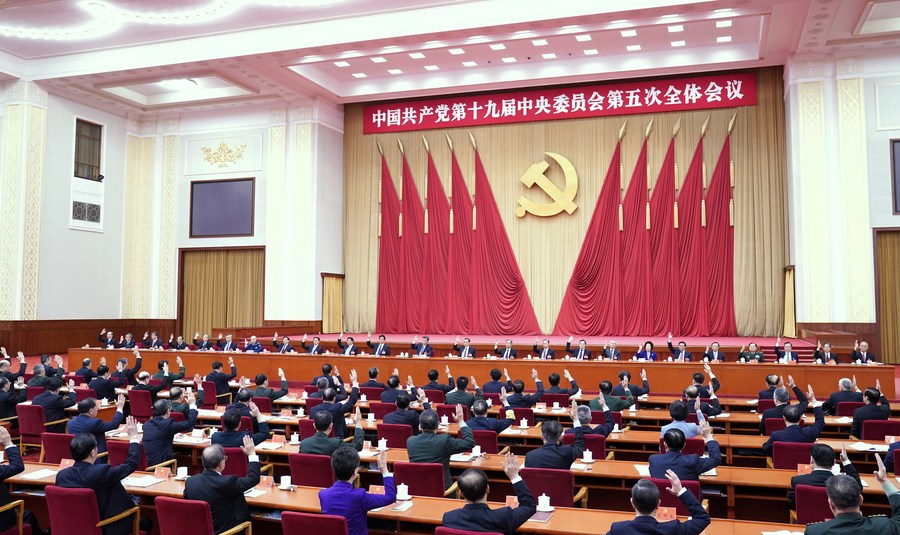
The Fifth Plenary Session of the 19th Central Committee of the Communist Party of China, held last week, laid out a comprehensive guideline for the 14th Five-Year Plan (2021-25), which covers major aspects of China's socioeconomic life.
The launch of the five-year plan is also a launchpad for China's second centenary goal of becoming a modern socialist economy by 2035. Several components of the five-year plan will have far-reaching effects on Africa, because China is the largest trading partner of the continent by far.
One of the widely discussed components of the five-year plan is the reliance on technology, innovation and science as the leading change factor. A focus on technology and innovation offers an opportunity to deepen technological cooperation and skill transfer between the two civilizations.
The plenum further made it a priority to share more technological outcomes with the world. This opens up opportunities for collaboration and cooperation with African countries in areas such as manufacturing, transportation, public health, agriculture and communication. China is currently facing unbalanced development, where there is heavy reliance on global market forces. However, it is important to note that China needs the world, but more important, the world needs China.
Joint scientific and technology research that is encouraged in the five-year plan will materialize through the dialogue that the CPC will encourage with all countries around technological policies, development planning and other areas related to technological cooperation. This is an opportunity for African countries to benefit from China's advanced technology to solve socioeconomic challenges on the continent. China's focus on innovation will help mutually beneficial economic cooperation and collaboration.
The plenum also put heavy emphasis on the "dual circulation" development paradigm to counter backlash against economic globalization. The growth pattern focuses on international economic development and cooperation as well as a strong domestic economic cycle. The thinking behind this is that, despite the fact that the hallmark of a strong economy is a smooth internal economic cycle, China still deeply appreciates the importance and benefits of deep engagement in international economic circulation.
As Africa's largest trading partner, a stronger domestic economic circulation within China will create a market for African exports, enhance Sino-African economic cooperation, and counter Western rhetoric about the need for "de-Sinification" of the African economy.
The CPC Central Committee resolved to continue opening up the economy and to avoid the unrealistic event of decoupling from the global economy. Opening up the Chinese economy underpins the CPC's commitment to enhance economic cooperation with Africa and solve the issue of trade imbalance by giving the continent more access to the huge Chinese market.
China has also renewed its commitment to reduce the impact of climate change. This will be done by stabilizing and eventually reducing its carbon emissions. The technological innovations touching on green energy can be part of the economic and technological cooperation with Africa to fill the energy gap on the continent and provide power to areas and people who are off the grid. This puts China in the position to be a strategic partner that will enable Africa to achieve the United Nations' Sustainable Development Goals of affordable and clean energy across the entire continent.
Cultural development as part of a thriving socialist modern China was given a prominent position in the 14th Five-Year Plan. China will use cultural exchanges as part of its strategy for the mutual benefit of both China and Africa. This will see more Confucius Institutes being set up as avenues of cultural exchanges and channels of cultural diplomacy between China and Africa.
James Muiga is a senior associate fellow of the China-Africa Center at the Africa Policy Institute, a Kenya-based think tank.










