



Villages visited by Xi shake off poverty









NO ONE LEFT BEHIND
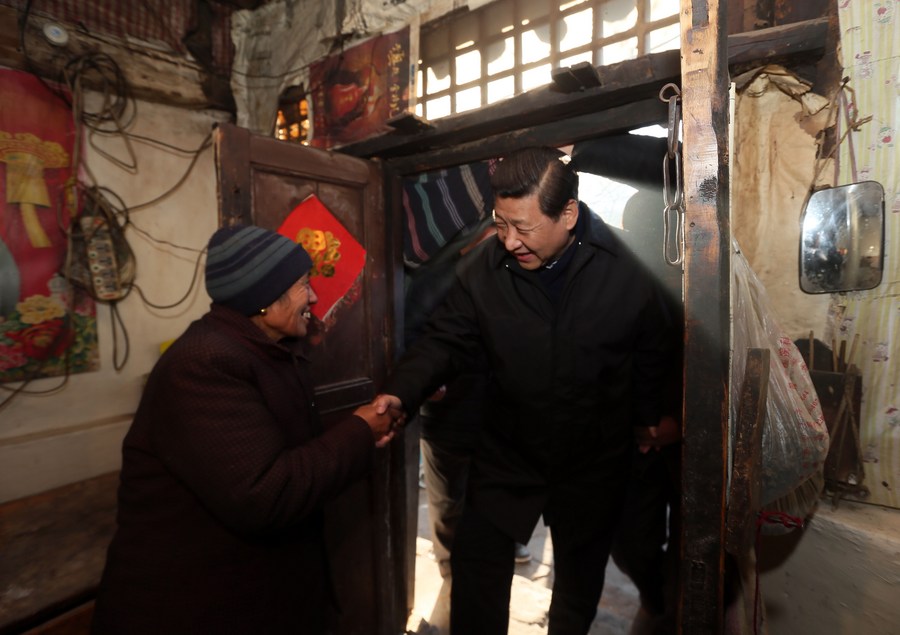
Long still remembers the details of Xi's visit. "We had a lot of people on that day. Some had to stand because we did not have enough stools," she recalled.
Shibadong Village has now become a tourist attraction not only for its beautiful rural landscape, but also because it is the birthplace of and a testing ground for targeted poverty alleviation efforts.
By receiving tourists, Long's rural-style restaurant brings the family an annual net income of 160,000 yuan (about $24,000). Her youngest son, who runs the restaurant, has just purchased a new car.
Long used to store her newest Miao-style clothes deep in her wardrobe, but now wears them every day.
"I'm tired of saving new clothes for the future as we can now afford them," she said.
From 2013 to 2019, the average annual per capita net income of Shibadong Village increased eightfold to more than 14,000 yuan.
China regards impoverished rural areas as the biggest challenge in completing the task of building a moderately prosperous society in all respects.
To meet the country's target of eradicating absolute poverty by 2020, with no one to be left behind, Xi has in recent years visited 14 contiguous impoverished areas and inspected 24 impoverished villages in Hunan, Shanxi, Chongqing, Ningxia, Shaanxi and other provincial-level regions, meeting villagers like Long.
As of October, the poverty rate of these 24 villages dropped to 1.9 percent from 36.1 percent in late 2012, with 23 having shaken off poverty. The per capita annual net income of registered impoverished villagers tripled to nearly 10,000 yuan.
In Luotuowan village in the deep Taihang Mountains of North China's Hebei province, villagers no longer have to climb the mountain and chop firewood for heating and cooking. Their new houses are equipped with underfloor heating and tap water.
Unlike in the past when many had nothing to do but squat at their doorsteps to bask in the sun in slack seasons, villagers are busy planting mushrooms, receiving tourists or preparing for the grape plantation.
"Upbeat about the future of our village and attracted by the local industries, many migrant workers like me have returned home," said Gu Tingchun, 64.
About one month after taking the helm of the Party in 2012, Xi braved the winter cold to visit the village in Fuping county, where he called for national efforts to battle poverty.
Inspired by Xi's words, Gu decided to quit his job as a furniture delivery man in Beijing to start a mushroom planting business back home, an industry that experts had found suitable for the local climate.
"If the greenhouses are properly managed, the mushrooms can be harvested for five times a year, bringing nearly 30,000 yuan of profit per greenhouse," said Gu, adding that he hired five farmers to pick the mushrooms, paying each of them 100 yuan every day.
Gu's wife cleans guestrooms in a homestay in the village, earning 2,100 yuan every month.
Benefiting from the mushroom and grape planting as well as rural tourism, the village saw the annual per capita income surge from 950 yuan by the end of 2012 to 13,620 yuan by the end of 2019.
During the same period, China's rural poor population was slashed from 98.99 million to 5.51 million, with the poverty ratio in rural regions dropping from 10.2 percent to 0.6 percent, through fostering industries such as produce processing and tourism, pairing-up support, as well as relocating those in barren and remote mountainous areas to more habitable regions.


- Niche tourism steals spotlight in China's bustling May Day holiday travel season
- Visit to Eswatini in spite of earthquake at home criticized
- Xinjiang entrepreneur Li Jianhong killed in Albanian car crash
- Henan massage parlor fire claims six lives
- Hebei hosts unmanned flight contest
- Artisans from across Hebei gather for woodblock contest





