


All A-level tourist spots are admission-free to attract more travelers.
Shi Manlin has enjoyed lower travel expenses during her travels across the country over the past six months after quitting her publishing-house job since the lift of the COVID-19 lockdown.
The 33-year-old and her friend, Lan Yun, recently traveled though Xinjiang, from Hami northward to Altay via Akasu, Ili and Karamay.
They spent two days hiking in Kanas. They hired two guides, rented two horses to carry their luggage and slept in tents.
The short videos Shi posted on WeChat captured the beauty of the bright leaves, sunshine, blue skies and turquoise springs. They mostly met group tours of elderly photographers along their way.
"Autumn is the most beautiful season for Kanas, and there are few tourists since Xinjiang has just reopened. That's why we went," she says.
"There are lots of rooms available in Kanas due to the epidemic. Otherwise, all the hotels would be full."
Shi and Lan also went to another national 5A-level scenic spot, Koktokay, in Altay's Fuyun county.
It's the hometown of Chinese writer Li Juan, whose essays about the traditional nomadic lifestyle of the local Kazak ethnic group have been translated into French and Korean.
Autumn is when herdsmen on horses or motorbikes ride beside the roads, driving sheep, cattle and camels to their winter pastures.
Li Juan faithfully records nomads' migrations and describes the simple white tents that sometimes stand alone on boundless wild land and other times cluster together near grazing sheep and cattle.
There are occasionally camels, too, especially in the Gobi Desert, which hosts little beyond scattered stones. That is, aside from where the sands approach the water, especially the Irtysh River that runs through Altay and empties into the Arctic Ocean.
Tall grass, forests and vast corn and sunflower fields abruptly thrive near its banks. It's a place that reminds us that water is the source of life, in every sense.
Koktokay means green wood in the Kazak language and blue river bend in Mongolian.
The road to Koktokay passes the Irtysh Grand Canyon and the bell-shaped Zhongshan Mountain.
People can hike, drive or cycle in a quiet valley where tall trees, flowers and grass shimmer along the springs.
It's said a cave in the area is scattered with precious stones.
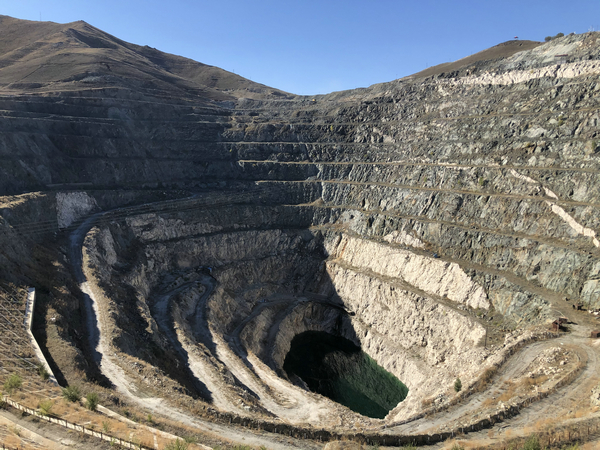
Another major attraction is the Koktokay National Geopark, where the No 3 lobe of a special mine contains 86 minerals, including 26 that are rare, which equals a majority of rare earths on the planet.
The former Soviet Union sent the first miners to the No 3 lobe in the 1930s, after they found sand that contained rare metals in the Irtysh's downstream region and traced their origins to Koktokay.
After New China's founding in 1949, the two countries signed an agreement to co-mine the site that ended in 1955, when China started running it independently.





