FAW's tech thrust gets into fast lane









China FAW Group Co Ltd, the Changchun-based State-owned automaker, plans to invest 110 billion yuan ($16.2 billion) in new technologies and products such as new energy, connected and smart vehicles during the 14th Five-Year Plan (2021-25) period, said its top executive.
"In response to the country's dual circulation development pattern, and its call to take control of key and core technologies, we have decided to increase digitalization of our products. We will form more partnerships with research institutes and companies in other sectors to upgrade the product range, amid the wider industry shift toward developing intelligent connected vehicles," said Xu Liuping, the group's chairman.
"Digital transformation is the core driver for upgrading and pushing high-quality growth of China's automotive industry," he said.
The future development trend of this sector should be deep integration and collaborative innovation between traditional automakers and internet-based companies, he said.
All the steps are digitally synchronized to ensure execution and complete alignment with customer demand, he said.
A number of global players from Germany, France, South Korea, Japan and the United States have already digitalized their entire value chain, from product design and research and development, to logistics, production and related services.
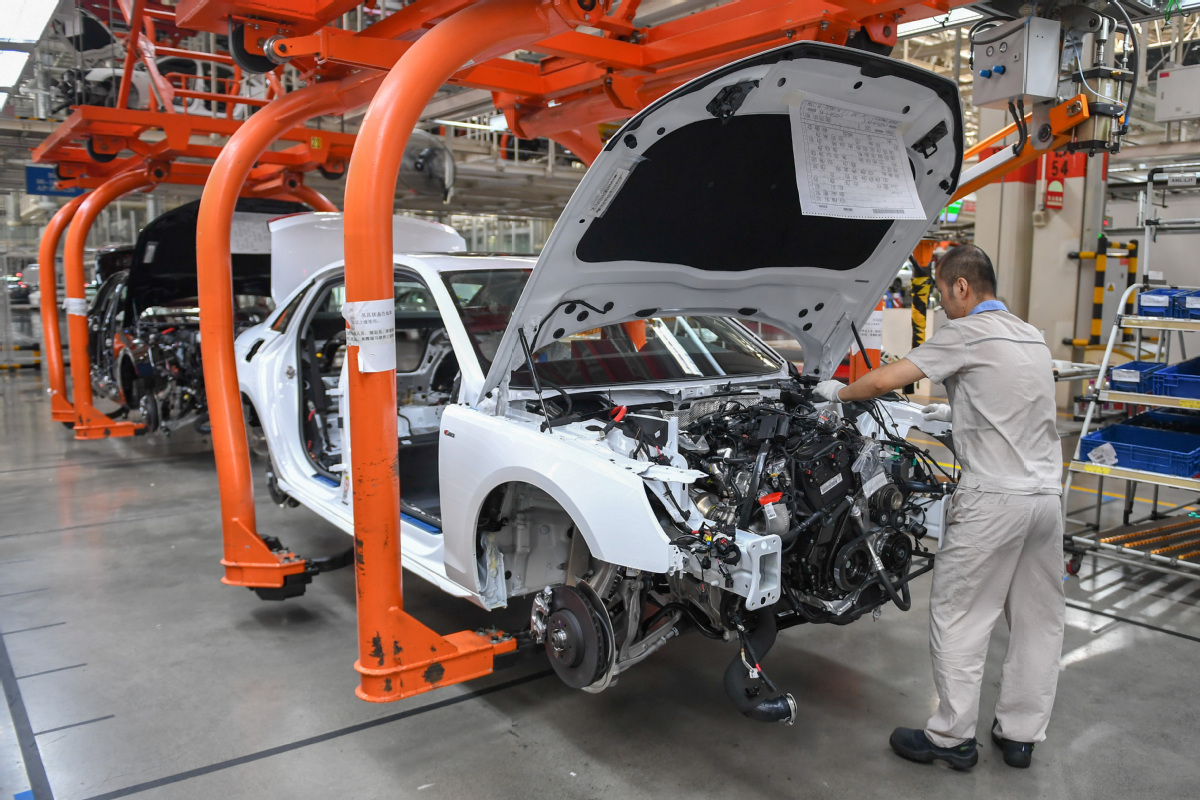
In addition to creating a collaborative design and virtual simulation platform based on digital twin approach, FAW Group, the owner of FAW Hongqi (Red Flag), FAW Jiefang and FAW Besturn brands, has also accelerated digital manufacturing and technical upgrade of its traditional manufacturing facilities.
A number of its digital factories are supported by 5G and industrial internet technologies. Its order delivery cycle has been significantly shortened and the company achieved intelligent production in key processes, including stamping, welding, painting and final assembly.
Xu said national development strategies and supportive industrial policies-building smart cities and charging infrastructure for electric vehicles; advancing digital economy; the application of 5G technologies; "new infrastructure"; and intelligent manufacturing-will empower the entire life cycle of research and development, manufacturing, and marketing services in the automotive sector.
Thanks to its growing investment in research and development, especially in areas such as modern design, digital and electric power-related technologies, sales of FAW Group reached 2.27 million units from January to August this year, up 6.4 percent year-on-year, despite a 9.7 percent fall in China's overall passenger car sales during the same period.
The centrally-administrated State-owned enterprise, which also runs joint ventures with carmakers such as Volkswagen and Toyota in China, saw its sales revenue reach 431.6 billion yuan, up almost 11 percent year-on-year, yielding a profit of 28.56 billion yuan.
Because the global automobile industry is undergoing profound changes, there are new trends like electrification, interconnectedness, smart control and shared systems in the development of the automobile industry, said Zhao Ying, a researcher at the Beijing-based Institute of Industrial Economics, which is part of the Chinese Academy of Social Sciences.
"Among them, the biggest factor driving technology is digitalization, and its impact on the automobile industry is all-round and in all fields," he said. "We found that consumers, especially the younger generation, rely heavily on the internet and pay close attention to a car's connectivity these days when deciding what to buy."
The company employs 130,000 in all at five domestic manufacturing bases and 16 overseas plants in countries such as Pakistan, Mexico and Russia. Over the next five years, FAW Group plans to expand its sales channels in markets related to the Belt and Road Initiative.
The company intends to build a complete industrial chain, and so has partnered with Fujian province-based Contemporary Amperex Technology Co Ltd, China's largest automotive lithium-ion battery maker by production volume.
Late last month, the two companies started to run a factory in Ningde, East China's Fujian province, to make batteries for FAW Group's electric vehicles.