



Tsai's attempt to sever relations across the Straits doomed to failure









The 12th Straits Forum, an annual meeting organized since 2009 to promote people-to-people exchanges between the Chinese mainland and Taiwan, held in Xiamen, Fujian province, on Sunday, was the first cross-Straits event since the COVID-19 outbreak and echoed the aspirations of civil society on both sides to increase exchanges across the Straits.
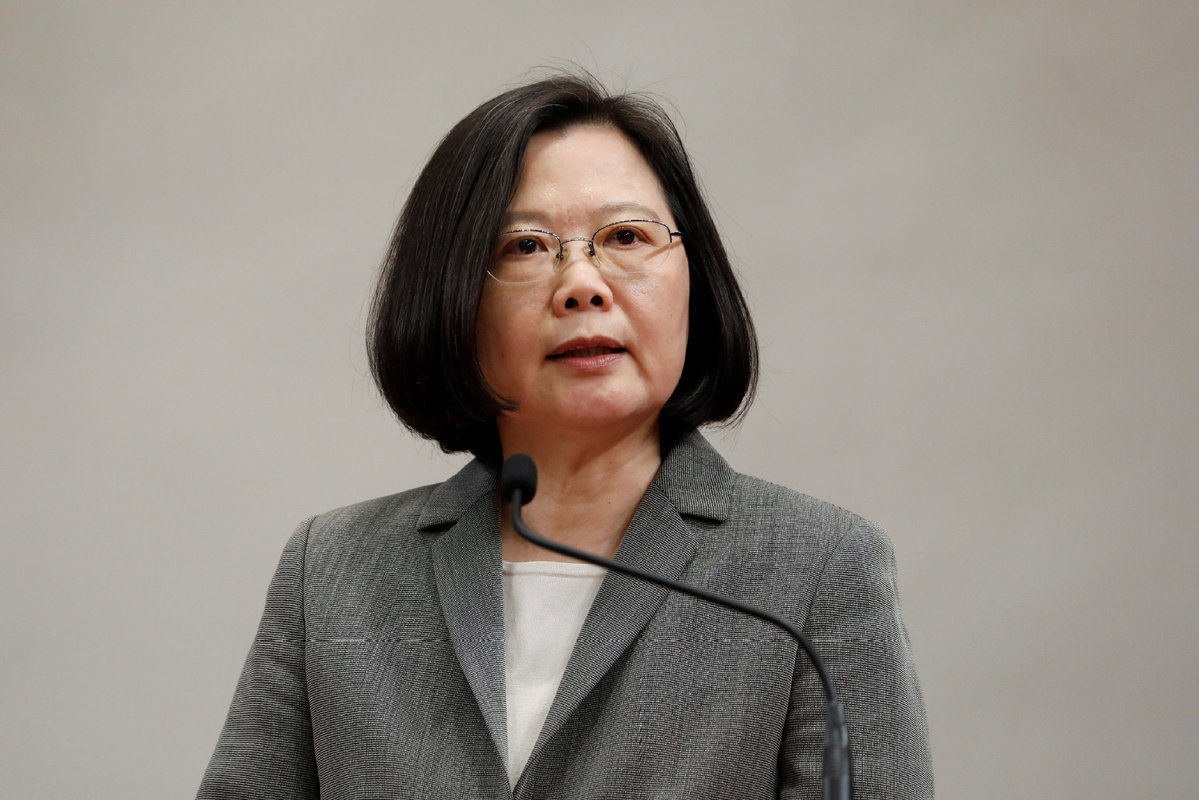
But the pro-independence Tsai Ing-wen administration in Taiwan, which has been hindering cross-Straits exchanges, said an "anti-infiltration law" will be used to penalize any potential "violator" in order to prevent the island's political parties, organizations and residents from participating in the forum.
Tsai and her ruling Democratic Progressive Party have been taking advantage of the pandemic to advance their "Taiwan independence" agenda while serving the United States' strategy to check the mainland's rise. Tsai has been trying to cut off economic ties with Beijing, and pressuring Taiwan businesses to shift their investments and production units from the mainland to either the island or any of the ASEAN member states by introducing a "new southbound policy".
Tsai has also limited the access of mainland funds and enterprises to the Taiwan market, including banning iQiyi and Tencent Video, both mainland-based video-streaming websites. The move is similar to the US' efforts to decouple from the mainland.
As Washington intensifies its attacks on the mainland's high-tech enterprises such as Huawei and ZTE, the Tsai authorities are playing catch-up with it to exclude mainland companies from such sectors as 5G, electronics and semiconductors.
The Taiwan authorities should realize cooperation with the mainland is to the island's benefit because the mainland is the only major economy to virtually contain the pandemic and resume near normal production.
According to the General Administration of Customs, cross-Straits trade from January to August reached $158.93 billion, up 10 percent year-on-year, with the island enjoying a trade surplus of $83.46 billion. In August alone, Taiwan's exports to the mainland and the Hong Kong Special Administrative Region accounted for a record high 46.39 percent of the total. And contrary to Tsai's policy, Taiwan businesses increased their investment on the mainland by more than half from January to July, compared with the same period last year.
The rising trade shows the DPP cannot reverse the trend of cross-Straits economic integration through political manipulations. In fact, cross-Straits trade has become more intertwined now than before the pandemic.
The mainland is committed to advancing economic integration with Taiwan. And unlike Tsai's policy, the mainland economy will further open up to Taiwan businesses and residents by giving them equal treatment.
In the post-pandemic era, the mainland is expected to register stable growth thanks to its vast market, and continue to be a main driver of global growth. And as Taiwan's largest export market and largest source of trade surplus (more than $100 billion a year), the mainland will keep boosting the island's economy.
So if the Tsai administration tries to decouple from the mainland, which it cannot, the island's economy would suffer a deadly blow. Tsai should realize that the island doesn't stand to gain anything by siding with the US, because the White House will cast Taiwan aside once it realizes it can gain more through strengthening Beijing-Washington economic relations.
The US ban on Taiwan Semiconductor Manufacturing Company for selling chips to Huawei virtually made the TSMC lose 20 percent of its market share. Yet, the US' top health official Alex M. Azar II visited Taiwan in August, Tsai announced the island will open up its market from next year to US pork with ractopamine, a feed additive to promote leanness in animals raised for their meat, which poses a significant health risk to Taiwan residents.
And the recent visit of Keith Krach, US undersecretary of state for economic growth, energy and the environment, to Taiwan aroused more concern on the island about whether the US will lengthen its export list for Taiwan. Still Tsai is eager to sign a free trade agreement with the US in total disregard of whether the island can bear the impacts of massive US farm exports and genetically modified food.
Whether the DPP likes it or not, Taiwan's future is closely tied to the mainland, and the mainland, under no circumstance, will allow the island authorities to decouple the two sides of the Straits, not least because Taiwan compatriots have to bear the brunt of such a scenario.
The author is an associate researcher at the Institute of Taiwan Studies, Chinese Academy of Social Sciences. The views don't necessarily represent those of China Daily.
If you have a specific expertise and would like to contribute to China Daily, please contact us at opinion@chinadaily.com.cn , and comment@chinadaily.com.cn





