'Separation of powers' wrong phrase for HK









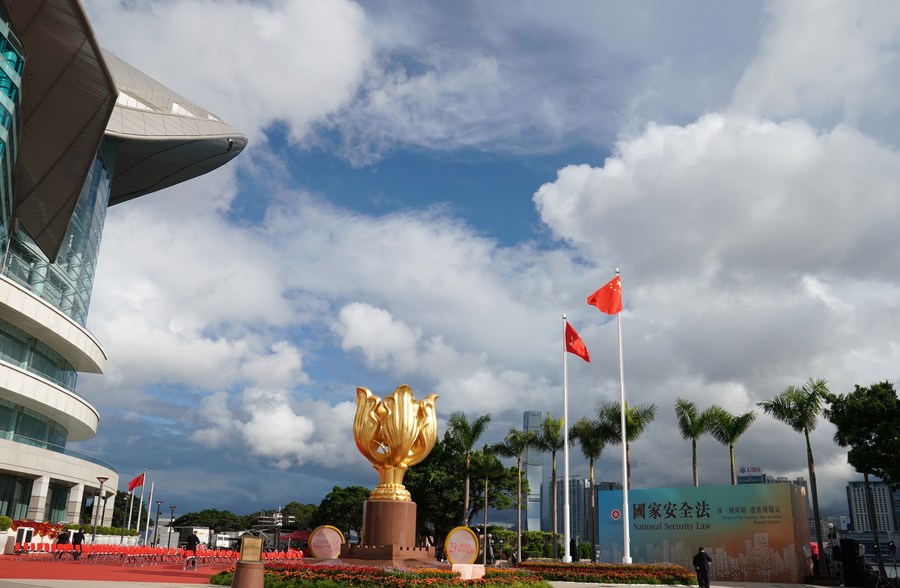
City officials back removal of political wording from Liberal Studies textbook
Legal experts in Hong Kong on Wednesday said it is incorrect to call Hong Kong's political framework a "separation of powers" as the city, a special administrative region of China, is not an independent political entity and all of its powers come from the central government.
What Hong Kong does have is a political setup that allows its executive, legislative and judicial branches to maintain checks and balances as well as cooperation, they held.
The remarks came after Chief Executive Carrie Lam Cheng Yuet-ngor and Education Secretary Kevin Yeung Yun-hung on separate occasions supported the removal of the phrase "separation of powers" from the Liberal Studies teaching materials that have been reviewed by the Education Bureau.
A more accurate way to view the relationship among the three branches of the government is that they perform their respective duties, exercise checks and balances, and cooperate with each other, Lam said.
According to the Basic Law, the central government grants administrative, legislative and judicial power to the Hong Kong SAR, and ultimately, the three branches are accountable to the central government through an executive-led system of governance with the chief executive at the core, Lam said.
Ronny Tong Ka-wah, senior counsel and executive councilor, agreed. Tong told China Daily that there was no "separation of powers" in Hong Kong's constitutional order under the Basic Law. Hong Kong's constitutional order is unique under "one country, two systems" and it is inappropriate to generalize the system using a term describing the governance of a country.
However, it does not mean that there is no division of power and checks and balances among the three branches in practical governance and operation, Tong said. For example, he said, one of the powers and functions of the Legislative Council is to examine and approve the budget proposed by the government.
He rejected some claims by local opposition politicians that "separation of powers" is a principle of common law jurisdictions and that to deny it would harm the independence of the judiciary.
He said such statements were "deceiving and misleading the public" as not all common law countries observe a strict distinction between powers. For example, in the United Kingdom's parliamentary system, the executive branch is not separated from the legislature, since Cabinet members are drawn from Parliament, he said.
Tong suggested that after the revision of the textbooks, the government should promote public awareness of the Basic Law and Hong Kong's constitutional order and prevent people from being misled by false claims.
Tam Yiu-chung, a member of the Standing Committee of the National People's Congress and member of the Basic Law Drafting Committee, said the "separation of powers "claim was inaccurate and misleading. The powers of each branch must be understood in accordance with the Basic Law, he said.
Under the Basic Law, the chief executive represents the HKSAR and is also the head of the executive branch. However, the power of the chief executive is not unlimited as he or she must govern in accordance with the law and is subject to oversight by the legislature, Tam said.




- Intl students showcasing global business acumen in Shanghai
- CPC expels former senior official of Guangxi
- Shanghai university unveils sustainable, efficient water treatment system
- Fire at auto business park in Jiangsu claims one life
- Magnitude 6.0 earthquake strikes Akqi county in Xinjiang
- Shenzhou XXI team to carry out first spacewalk