



Learning about Earth's past through the microscope









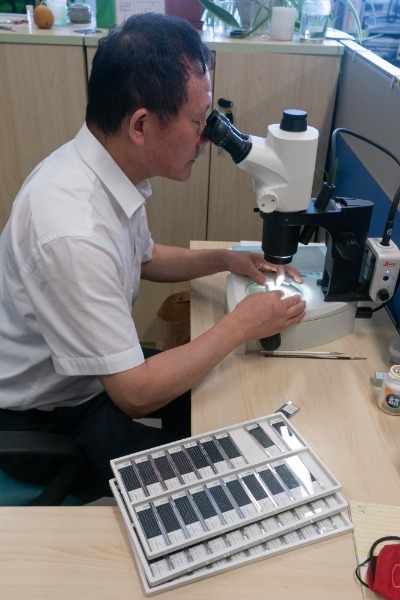
While visitors are most awed by the huge skeletons of dinosaurs or mammoths in the Shanghai Natural History Museum, researcher Zhou Baochun finds the world presented to him by the microscope far more intriguing.
A paleontologist of the museum, Zhou primarily studies fossils of the ostracoda, a type of crustacea that has been living at the bottom of ocean floors for millions of years.
He says that these tiny creatures, more commonly known as seed shrimp, are important in the study of the ocean's ancient climates.
"For most of my career, I have studied the ostracoda," he says, adding that when he joined the museum in 1996, there were only a few dozen specimens of the creature.
Over the years, Zhou has helped the museum collect 30,000 fossils of the tiny creature. Most of the specimens, which can be as tiny as 0.3 millimetres in size, were contributed by scientists who had participated in China's expeditions in the Arctic.
Zhou says that some of the specimens were extracted from the surface sediments of the Arctic Ocean floor, while others were found in the rock cores discovered from the seabed of the Chukchi Plateau.
Different species of ostracoda in the ocean - there are about 8,000 of them - thrive in varying environments. Different water temperature, salinity and dissolved oxygen level attract different species of the tiny creatures.
"I compare the distribution of ostracoda fossils in the rock core and on the current seabed to reconstruct the ocean climate in the Arctic as it was 100,000 years ago," Zhou says.
The study, which is nearing its end, was monotonous, laborious and required great patience, says Zhou. For example, Zhou had to clean and dry the raw samples of sediment and use a microscope to place the tiny ostracoda onto slides before indexing them into different catalogs.
The study was also a lonely journey. Zhou says less than 30 people in China are studying ostracoda today, and even fewer study them in the ocean. Zhou says he was happy to see a new colleague join him in 2017.
"People are eager to know the history of the Earth, and it's lucky that we have ostracoda, a witness of the planet's past," he says.
Zhou is one of the 40 researchers at the nature history research center founded in 2014 to strengthen the research function of the museum.
To date, the center has published 18 monographs and 92 papers in academic journals around the world, as well as undertaking 75 research projects commissioned by national and municipal foundations.
Researchers at the center have also added nearly 100,000 specimens to the museum's collection, which currently has 397,000 pieces.
Zhang Yunfei, director of the center, says,"We used to pay more attention to the front of the museum, such as the exhibitions and displays, but we are now starting to focus more on expanding our collection through research."















