



Centuries-old bridge collapses in Huangshan









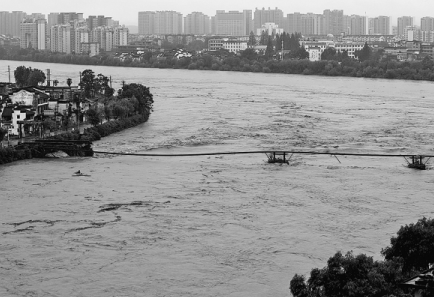
When a centuries-old stone bridge collapsed in Tunxi, the downtown district of Huangshan, Anhui province, on Tuesday morning, sighs soon overwhelmed social media around China and in the historic city in particular.
Zhenhai Bridge, whose name literally means "to pacify the ocean", failed to hold its ground against the roaring floodwaters of the Xin'an River during a heavy rainstorm that started on Monday.
The seven-arch bridge, which is 133 meters long and 15 meters wide, was constructed in 1536 during the Ming Dynasty (1368-1644) and had been hit by multiple floods ever since.
It was rebuilt in 1676 and 1699 and underwent a major restoration in 1884 during the Qing Dynasty (1644-1911), followed by several partial renovations in modern times.
In October, the bridge was inscribed onto the most recent list of the cultural heritage sites under national-level key protection due to its historical significance.
Situated at the gateway of the historical neighborhood of Tunxi, the bridge used to be an artery road, but after a new bridge was built nearby last year to improve transportation, Zhenhai Bridge was used only for pedestrians.
According to a statement from the Huangshan city government, no one was injured in the accident due to the bridge being locked down before the collapse after some passersby noticed the bridge piers were partially damaged.
For nostalgic locals, Zhenhai Bridge was simply known as "the old bridge".
"I used to go across the bridge every day riding bicycles during my high school years," Niu Ling, an IT company employee working in Barcelona who is from Tunxi, told China Daily. "We thought the old bridge would always be there because it was part of our everyday life, and hardly thought of taking pictures of it.
"However, only when we saw on the internet that the cultural heritage site was suddenly gone, we began to feel that it was a spiritual pillar supporting our deepest emotion for home," she said.
Zhenhai Bridge was not the only victim of the rampant flooding across southern China these days.
According to the National Cultural Heritage Administration, over 130 cultural heritage sites in 11 provincial-level administrative regions had been destroyed or damaged in the ongoing floods as of Tuesday.
For example, in Xuancheng, a city next to Huangshan in Anhui, Lecheng Bridge-a heritage site under provincial-level key protection-which was also first built during the Ming Dynasty and was rebuilt during the Qing Dynasty, collapsed on Monday.
In the UNESCO World Heritage site Wudangshan Mountains, an ancient architectural complex for Taoism in Shiyan, Hubei province, a temple from the Qing Dynasty was severely damaged by flooding as well.
The administration released a statement on Tuesday night urging local governments to keep an eye on the effect of flooding on cultural heritage sites and make sure any damage is immediately reported to local cultural heritage administrations.
"Cultural heritage administrators should cooperate closely with emergency management, environment and meteorological departments to screen for possible dangers and minimize loss," the statement said.
"And the construction materials (torn apart by the flood) should be carefully searched for and preserved."
"Good preparation is crucial to counter such natural disasters, particularly for smaller architectural structures," said Liu Qingzhu, a researcher with the Institute of Archaeology at the Chinese Academy of Social Sciences. "If abundant information was surveyed and recorded in detail beforehand, future restoration would be much easier."
An expert panel organized by the Anhui Provincial Cultural Heritage Administration arrived at the site of the Zhenhai Bridge on Tuesday afternoon.
Due to the abundant mapping and surveying done previously, rebuilding "would not be too difficult", according to a report from Anhui TV.
Liu emphasized that new technology should be adopted when restoring cultural heritage sites. For example, after the devastating 8.0-magnitude earthquake that hit Sichuan province in 2008, many restored ancient structures added modern earthquake-proof facilities.
"Though sticking to original materials and craftsmanship is widely hailed as a fundamental principle in restoring cultural relics, to better serve today's people, modern technology has to play a key role as well," Liu said.



Today's Top News
- Flood of opportunities in ecological preservation
- China urges US to honor its commitments
- Two former defense ministers get suspended death verdict
- Understandings 'reached' to ease naval blockade
- Stable Sino-US ties linked to global growth
- China, US urged to work for more practical results





