


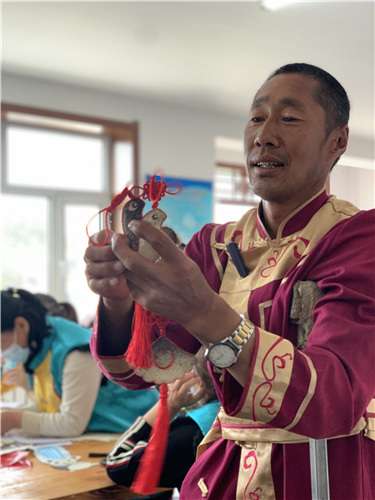
Traditional fishskin crafts of China's Hezhe ethnic group are driving new business opportunities.
Editor's note: A xiaokang society, or a moderately prosperous society, has been the dream of Chinese people for thousands of years. Our reporters travel around the country to cover the arduous efforts being made in order to realize the dream.
"Fishskin is as soft as that of any other animal. Its beautiful colors reflect the magnificence of the sunlight. Make clothes and socks with it, it's the brocade bestowed on fishermen." This is how Shen Zhaoshi, a poet from the late Qing Dynasty (1644-1911), praised the beauty and practicability of fishskin.
Today, a Chinese ethnic group named Hezhe still heed the poet's mantra. According to the last national population census of 2010, the total population of Hezhe was 5,354, with 3,613 living in Heilongjiang province. Liu Guiling, the head of the Heilongjiang Provincial Ethnic and Religious Affairs Committee, notes that Hezhe people mainly reside in seven villages spread across three towns, Jiejinkou and Bacha in Tongjiang city and Sipai in Raohe county of Shuangyashan city.
The name of the group can mean "people in the East", as well as "people living along the river" and fishing and hunting have shaped their way of life for more than 6,000 years. They have been making clothes from fishskin for at least 1,000 years.
The fishskin outfits, including the thread used for sewing, are usually made of materials harvested from bighead, pikes, sturgeon, carp and keta salmon. These particular sources are chosen to ensure the clothing become water-resistant and able to withstand wear and tear, allowing the Hezhe to hunt and fish in inclement weather and the sometimes harsh natural environment.
One set of clothes will usually employ between 100 and 200 sheets of fishskin and requires a craftsman to put in more than 50 days of painstaking work.
According to Sun Yulin, a 62-year-old representative inheritor of Hezhe fishskin art from Heilongjiang, the process is rather complicated.
As soon as the donor fish dies, the craftsman must act quickly, peeling off its skin in one single sheet and mounting it on a flat wooden surface. When the sheet is dry, it is laid on corn flour and squeezed to remove any oil still on the surface or inside the skin. It is then rubbed with the hands until it becomes soft.
But Mother Nature's bowl is not a bottomless one, and the fish stocks are not inexhaustible. As such, fishing as a main source of income for the Hezhe people was abandoned decades ago. In recent years, they have developed a tourism industry designed to help spread their ethnic culture and crafts to the wider world.
Sun had been a full-time fisherman before a folk customs park was built in his village in 2000. Under the tutelage of his third uncle, Sun Youcai, a famous fish bone and fishskin artist, Sun Yulin began learning to cut fishskin. Soon, he was capable of making small, two-dimensional animal collages from the material. As he grew more adept, he began creating larger, one square meter pictures of landscapes and animals with a more realistic appearance.
In June 2006, Hezhe fishskin handicraft was among the first batch of skills inscribed onto China's intangible cultural heritage list. This national recognition of the traditional craftsmanship of Hezhe motivated Sun Yulin even more.
He currently owns a small store selling Hezhe fishskin art in Jiejinkou town, Tongjiang, Heilongjiang province. It is the birthplace, and still a main habitation, of the Hezhe-one of the smallest ethnic groups in China. There are over 1,500 people living there now, accounting for about one-third of the group's total population.
Wearing a blue silk top with black linen trousers, Sun Yulin points to a fish-skin jacket hanging in his store. He says it required the skins of more than 70 keta salmon to make-each of which weighs around 4.5 kilograms.
"The price of a fishskin jacket is more than 10,000 yuan ($1,415)," Sun Yulin says, before explaining the reason for the jaw-dropping figure. "The tension of fishskin is seven times stronger than cowhide, it's unbelievably airtight and sturdy. A fish-skin suit will last a hardworking fisherman for six or seven years."





