



Swappable batteries gain traction nationwide









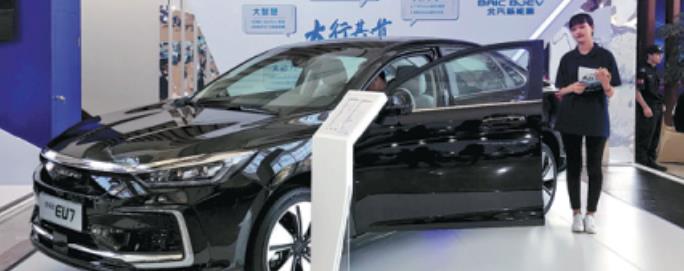
BJEV, the largest electric car maker in China, said on Friday that its fleet of vehicles with swappable batteries will grow to around 30,000 by the end of 2020.
It is also planning to build 100 battery swap stations in the second half of 2020, in cities including Beijing and Xiamen in Fujian province, bringing the total to 300.
The announcement came as building battery swap stations was included in China's Government Work Report in May. It was a sign of the nation's approval of a technology that many believe is the answer to people's doubts over electric vehicles.
Lian Qingfeng, BJEV's spokesman, said inconvenient charging has replaced mileage anxiety as the biggest factor that dissuades potential electric car buyers.
He said charging at private garage piles is the best way for electric cars, but less than half of Chinese electric car owners have a private garage or even a fixed parking space.
Battery swap technology solves this problem. At BJEV's battery swap stations, vehicles can get their empty batteries replaced by fully-charged ones within 90 seconds.
The technology solves another problem as well: depreciation. Electric cars are more expensive than gasoline ones because of the batteries, which usually account for some 40 percent of a vehicle's cost. Added to this, as scientists develop batteries with longer ranges, it becomes harder for second-hand electric cars to fetch a decent price compared to gasoline ones.
Lian said the company is considering selling vehicles without batteries, which they can get at battery swap stations. In this way, people can pay much less to buy an electric car and not worry about the depreciation of aged batteries.
William Li, founder of China's leading electric car startup Nio, has a similar argument. He says vehicles with swappable batteries enable car owners to continuously benefit from progress in battery technology.
Statistics show that electric cars had an average range of 160 kilometers in 2015 with the figure rising to 350 km in 2019. Their power consumption per 100 km fell from 17 kilowatt-hours to 14 kWh.
Economically, the battery swap stations are working well. A station with 28 batteries needs no more than 70 square meters of space and costs 3 million yuan ($423,649) to build. It usually takes 30 months to make money, said Wang Chunfeng, a senior sales executive at BAIC Group. Customers of BJEV's charging stations are usually taxi companies.
A survey shows that vehicles with swappable batteries can take 25 percent more orders than electric vehicles that have to be charged.
Nio, which has 132 stations across 58 cities serving only private cars, are doing a decent business too. The company said that they have completed more than 500,000 swaps as of May since the first station was set up in 2017. "That means it works for individuals as well. But if you serve private car owners, you have to have a bigger network of more battery swap stations," said Wang.











