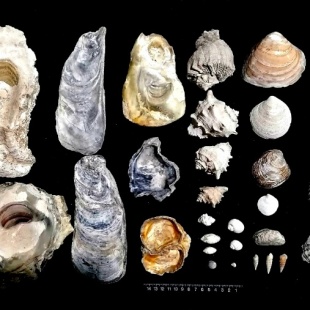



A shell of a discovery









Silver lining
Nevertheless, Sun's speculation probably has good grounding.
Only 1.5 kilometers away, there is a site of Hemudu Culture, a name famed in the world of archaeology. It is home to the, currently, earliest-known example of mortise-and-tenon joint used in Chinese architecture.
It was Hemudu Culture, which dates back 7,000 years and was discovered in 1973, that first made academia realize the significance of the Yangtze River to the origin of Chinese civilization. Previously, the focus was on Central China and along the Yellow River.
It also captured public attention with its splendid pottery. However, where this culture came from remains a mystery despite nearly half a century of research.
Were the residents of Jingtoushan its ancestors?
There have been a multitude of pottery shards found in Jingtoushan. As well as their similarities with Hemudu artifacts in their patterns and decorations, the new findings also feature some unique characteristics.
The geographical affinity gives people much room for imagination, but the 1,000-year chronological gap provides a threshold for easy judgment.
"We cannot say Jingtoushan is the direct origin of Hemudu Culture, but they at least appear to belong to the same family," Sun says. "If Jingtoushan was not Hemudu's 'father', it might be the 'grandfather'."
Sun cites that shell mounds almost simultaneously stopped being formed across all of coastal China after around 2,000 BC, when cultivated grains were widely accepted as people's dominant source of sustenance following a growth in the population. That would also probably explain why no shell mound has been found in Hemudu Culture, which had a well-established rice-growing technique.
That said, in Jingtoushan, the discovery of carbonated rice shows that the grain was included in the locals' diet, while rice hulls were also used in materials for making pottery.