



Combating COVID-19: Challenge and opportunity









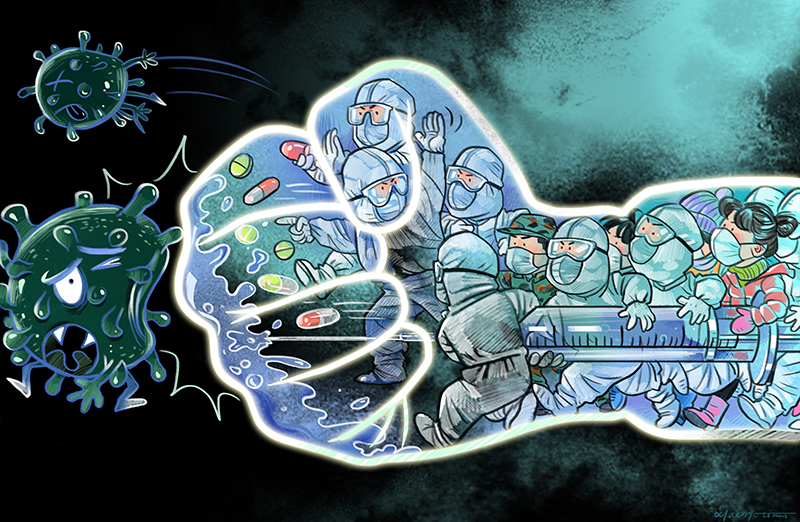
The start of the New Year, coinciding with the beginning of a new decade, is seeing an epic crisis of global proportions -- an unprecedented global pandemic, probably the most serious such challenge in the past 100 years. The coronavirus or COVID-19, as it is labeled, is testing not only the human spirit, but also each country's capacity to confront it and the international community's ability and willingness to come together and cooperate in jointly combating COVID-19.
COVID-19 is somewhat unique in that it does not recognize any boundaries or barriers of religion, country, race, continent or class. It can hit any and every person with equal ferocity and, today, no county in the world has so far been able to find the cure for it. In fact, as the saying goes, prevention is the cure.
In analyzing COVID-19 and its global impact, some key lessons are relevant. First, since China was initially the hardest hit of countries, its handling of the crisis merits attention. In this crisis, where even the WHO has praised China's role and effective policy of early detection through widespread testing and early treatment coupled with quarantine of the affected areas is proof of the quality of leadership, efficiency and capacity of the healthcare system, and overall governance and administrative framework that enabled China's success in effectively combating the coronavirus. President Xi Jinping showed remarkably decisive leadership, taking tough measures in a short span that produced positive results. For example, two special hospitals for COVID-19 patients were constructed within 10 and 12 days each, respectively, in Wuhan, Central China's Hubei province, with a total capacity of 2,500 beds. Then Wuhan was kept under a 76-day lockdown which was pivotal for containing COVID-19. Equally important was the coordination of personnel and supplies, with the result that over 42,000 medical personnel rushed to Wuhan from all parts of China to take part in this heroic battle against the invisible, faceless enemy.
After winning this battle within China, a positive example of global camaraderie emerged with China providing leadership by sending medical teams to several countries of the world, to share their experiences and provide urgently needed medical equipment.
The second lesson is relevant for us as Pakistanis, being neighbors of China, with a very close and historic "all-weather friendship", as both Pakistan and China are considered "Iron Brothers". Pakistan was one of the first countries to airlift masks to China on Feb 1, when it faced a shortage of masks. On Feb 10, I sponsored a resolution in the Senate, the Upper House of Pakistan's Parliament, expressing solidarity with China, appreciating the leadership of President Xi Jinping and thanking China for treating Pakistani students in Wuhan "as their own". This resolution was passed unanimously and the Pakistan Parliament was the first parliament to pass such a resolution of solidarity with China during this COVID-19 crisis. The president of Pakistan also visited China on March 16-17 to express solidarity with China. Pakistan was one of the first countries which was the recipient of China's medical assistance, both medical personnel as well as equipment such as 217 ventilators, 100,000 testing kits, 70,000 sets of protective gear for health workers and 2 million face masks. In fact, the Chinese government and Chinese companies gave preference to Pakistan, by airlifting such medical assistance on daily basis during a weeklong period which started on March 25 till April 3. This was a living example of two countries cooperating in crisis, with China helping those in need after having contained the crisis at home.
The third lesson of the COVID-19 pandemic is that the politicization of the virus or stigmatizing, blaming or name-calling countries, on the basis of politics, ethnicity or ideology is counterproductive, and certainly no solution to the crisis. In fact, in a shameful and reprehensible development, some Western countries also resorted to blatant racism and ethnic profiling during this COVID-19 crisis. Racism as a factor in US policy towards China has been mentioned by writers, both in the East and the West. In his recent book Has China Won?, the distinguished Singaporean diplomat and academic Kishore Mahbubani hit the nail on the head, quoting an important US policymaker as saying that the American “contest with China was with a ‘non-Caucasian’ power. In doing so, she put her finger on what is driving the emotional reactions to China”.
Writing in The Washington Post on Feb 5, John Pomfret in his article The Coronavirus Reawakens Old Racist Tropes Against Chinese People, wrote that this medical crisis has also “reawakened centuries-old prejudices against the Chinese people.” The article even referred to the 1882 China Exclusion Act passed by the US Congress, a law which targeted China and the Chinese people, banning Chinese workers from traveling to the United States.
Regrettably, the United States has gone beyond negative rhetoric to even withholding funding for the WHO, which is the leading global organization in the fight against COVID-19, an action that has been condemned internationally. The London-based Guardian titled its April 15 story as "A Crime Against Humanity" since this action has been taken at the height of the COVID-19 crisis, undercutting international institutional efforts to curb and contain this existential threat to humanity.
Barring this aberration, which is partly driven by racism and partly by domestic political considerations of President Trump since, facing a tough election, he wants to divert attention by blaming China and the WHO to cover up his own failings in effectively combating COVID-19, the international community has risen to the occasion to express camaraderie through mutual cooperation and joint efforts against this unique enemy in a war which is being fought not with armies or tanks or bombs but through medicine, hospitals, doctors and nurses. The health workers are universally recognized as the heroes and front-line warriors in this battle against the virus.
Like climate change, COVID-19 has brought home the reality that globalization is the only way forward for humanity to save itself from similar crises in the future. No one country, no one continent, no one institution alone can do this as the "common enemy" requires a collective effort through joint cooperation in which China has demonstrated not just leadership but the vision and the will to match its words with deeds, producing positive results in the process, both at home and abroad.
Senator Mushahid Hussain, chairman of the Pakistan Senate Foreign Affairs Committee.
The opinions expressed here are those of the writer and do not necessarily represent the views of China Daily and China Daily website.





