Lab worker braves risks by tackling tests in hardest-hit city









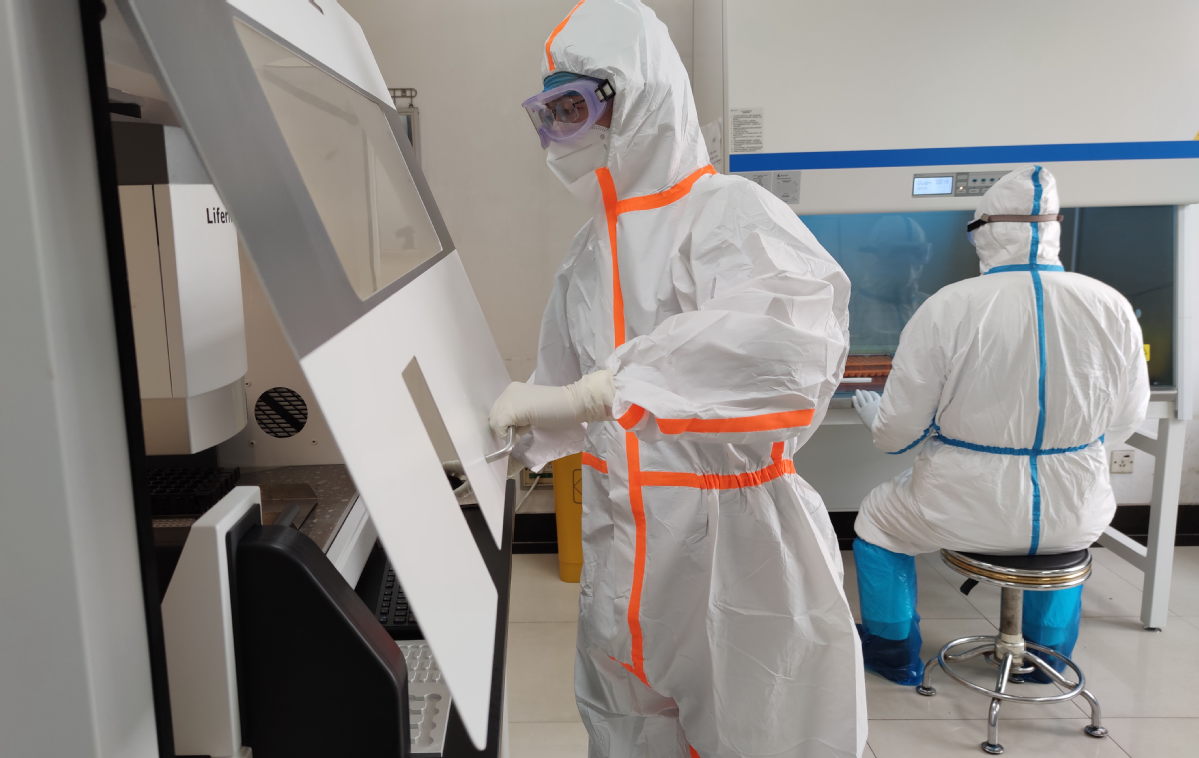
Chen Liujun, 29, works with a team to examine nucleic acid samples in Wuhan
In the fight against the novel coronavirus, there are people called "behind-the-scenes heroes" for the key roles they have played. Chen Liujun from Wuhan No 4 Hospital in Wuhan, Hubei province, is one of them.
Chen, 29, who works for the clinical laboratory of the hospital, has been working with nucleic acid tests since shortly after Wuhan was hit by the outbreak in late January. Looking back, he said the past two months were tough for him but helped him grow a stronger sense of responsibility.
Chen joined the hospital two years ago after graduating from Wuhan University with a master's degree in virus immunity. However, he never imagined that what he learned in his university would be used in "a war on the epidemic".
When the novel coronavirus broke out in the city, his hospital was one of the first to be designated to treat infected patients.
"It's important to detect, isolate and treat the patients in a timely manner in dealing with the contagion caused by the novel coronavirus, and the nucleic acid test is critical in the diagnostic procedure," Chen said.
However, at the outset of the epidemic, only a few medical facilities in the city were qualified to conduct such tests because, among other reasons, the test procedures are complicated and need to be conducted in higher-level biosafety labs and hospitals, which are short of specialists, Chen said.
As more and more people rushed to hospitals due to the disease, the facilities failed to meet the increasing demand. At the end of January, Chen's hospital was instructed to conduct nucleic acid tests as an emergency task.
When the hospital called for the establishment of a special task force for the test work, Chen, as a Communist Party of China member, volunteered to offer the services.
"We transformed our labs within 48 hours, and in the meantime we formed a nine-member team. All of us were trained by specialists with the knowledge of biosafety protection and the skills to conduct nucleic acid tests," he said.
Chen remembers the first time he conducted a test.
"My three colleagues and I entered the labs wearing protective gear," he recalled. "As we had never done the test before, the main task for us was to work out a guideline for handling and processing the specimens so that we could standardize the procedures," he said.
Nucleic acid extraction is the most dangerous part of the procedure as it requires the operators to be physically close to the virus, Chen said.
"At the very beginning, I had no worries about the risks, though I know they were there," he said. "However, when more and more specimens tested positive, I felt a little bit of panic because I was aware that the lab where I worked had become more dangerous."
To ensure their safety, Chen and his colleagues take the most rigorous measures to protect themselves from infection. In addition to equipping themselves with full protective gear, including protective clothing, goggles, face masks and rubber gloves, they spend at least half an hour disinfecting the labs with ultraviolet lamps before and after conducting a test.
He and his colleagues usually work seven-hour shifts conducting tests every day, during which they cannot eat or drink or go to toilet, Chen said, adding at the peak of the epidemic, they handled around 300 samples a day.
Despite the risks, neither Chen nor his teammates have backed off.
"The hospital and the labs are our battlefields. We know what we are doing here, and we hope our efforts can help doctors make targeted diagnoses and treatment plans to save more patients," Chen said.
Epidemic control in the hardest-hit city has made great headway. On Sunday, there were 577 patients hospitalized in the city due to the disease.
Chen said he hoped the epidemic will end soon so that people in the city can resume their normal lives. Due to his busy schedule, he has not seen his parents or girlfriend since the start of the outbreak.
"When the epidemic ends, I want to see them. Also, I want to go to a concert to see my favorite Taiwan singer Jay Chou, as I'm a loyal fan," he said.


- Xizang's remote villages gain access to express delivery services
- Egyptian man explores 460-year-old fair in Tianjin
- 10,000-ton electric container ship tests off Jiangxi province
- China's construction sector sees drop in energy use, emissions during build phase, rise in operations
- Guangdong sees surge in holiday arrivals as travel pattern shifts
- International commercial court established in Guangzhou