Strengthened regional solidarity
Pandemic has prompted countries in East Asia to consolidate their coordination and cooperation









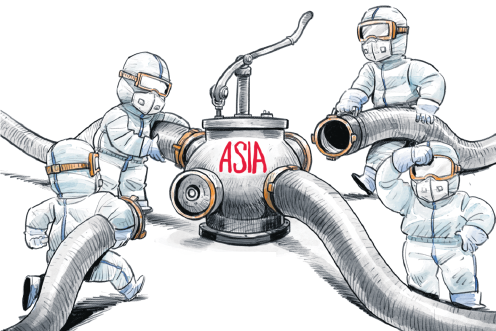
The novel coronavirus pandemic has had a widespread and profound impact on global cooperation. Due to financing and jurisdiction constraints, international organizations such as the World Health Organization are unable to provide sufficient assistance and support to all the regions of the world. In light of this, East Asian countries are already improving and innovating the models for coordination between countries based on existing regional collaboration frameworks to fill in the gaps in the supply of global public goods.
Since the severe acute respiratory syndrome (SARS) outbreak in 2002-03, East Asian countries have been systematically strengthening their epidemic response capacities through setting up national disease control centers and national public health labs, as well as strengthening primary healthcare systems. Nevertheless, the sudden outbreak of the novel coronavirus has still put great pressure on the public health systems of countries in the region. In particular, countries such as the Philippines and Indonesia are at risk of the epidemic spreading due to their population densities and decentralized hospital systems. To prevent shortages in medical supplies as a result of the pandemic, these countries must stock up on antivirals and medical equipment in a timely manner to meet the emergency needs of local health sectors.
In addition, the pandemic has affected the economy, trade and even the societies of countries in East Asia. The International Health Regulations call on countries to "avoid unnecessary interference with international traffic and trade" as they act to respond to a public health threat. However, some countries have been violating the IHR and imposing personnel and trade restrictions without proper notification to the WHO, which has taken a toll on related sectors in East Asia.
In addition to its health impacts, the outbreak has had profound socioeconomic consequences. To mitigate these, East Asian countries have started to respond with different measures and strengthened cross-border, cross-sector and cross-cultural communication and coordination to upgrade regional cooperation frameworks.
First, regional cooperation has to do with multi-level health cooperation. In the area of policymaking, East Asian countries have hosted conferences such as the Association of Southeast Asian Nations (ASEAN)-China Health Ministers Meeting and ASEAN Plus Three Senior Officials Meeting on Health Development, reaching broad-based consensus on joint prevention and control. In diagnosis and treatment, health practitioners across East Asia have been exchanging solutions through videoconferencing and other channels. Specialists and healthcare professionals have also been dispatched to provide health services in East Asian countries with weaker healthcare systems. For example, a team of doctors and nurses from the Guangxi Zhuang autonomous region was dispatched on March 23 to provide assistance to Cambodia. Likewise, the research and development of specific drugs and vaccines call for the sharing of data, technology, experiences and capacities to encourage solidarity with less well-funded institutions.
Inter-agency economic coordination is also important. At the Special ASEAN-China Foreign Ministers' Meeting on Coronavirus Disease (COVID-19) held on Feb 20, the foreign ministers of the participating countries emphasized the importance of stabilizing supply chains and inter-agency coordination to minimize the impacts on the economy and trade. They also proposed various measures to keep markets open, facilitate the sharing of information on risks, expand digital trade and reduce non-tariff barriers.
In March 2020, China and the Republic of Korea set up a collaboration mechanism for joint prevention and control of the coronavirus. Spearheaded by the respective foreign ministries, the initiative also involves sectors such as health, education, customs, immigration and aviation to ensure essential trade and personnel flows. Shortly afterward, China, Japan and the ROK held a special foreign ministers' meeting on the pandemic, paving the way for further expansion of inter-agency coordination across East Asia.
There has also been an increase in exchanges and solidarity among local governments and communities in East Asia in the fight against the virus. And with information flows now faster and wider than ever thanks to social media, the public's access to information has been greatly expanded, although this has also facilitated the propagation of fake news and rumors, which can trigger fear and prejudice among the uninformed. Discrimination against Asians in the West during the early days of the outbreak being a case in point. In light of this, East Asian countries have been strengthening their communication to provide clear, accurate and timely information to fully inform people of the evolution of the epidemic and various countries' prevention and control measures. The national governments of East Asia have also been calling for rational responses and speaking out against all acts of racial discrimination in a joint effort to prevent attempts to stigmatize any country or region through attributing blame.
Even though East Asia was among the first regions hit by the novel coronavirus, mutual support and coordination between countries has led to effective control of the spread of the epidemic. The experience of East Asia teaches us that international public health governance goes beyond health-sector cooperation. Customs, transportation, immigration and the media must act in coordination with broad-based, comprehensive local measures. As we fight against the virus together, East Asia is enhancing its institutions, interagency coordination, people-to-people ties and information sharing, laying the foundation for a community with a shared future in Asia.