



Identity crisis









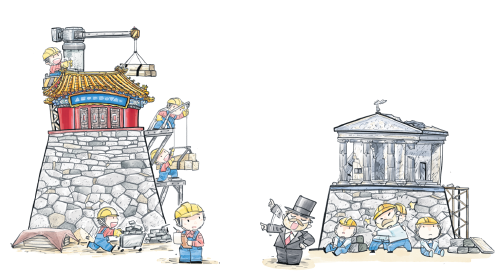
West's unfounded fears of China are simply a harmful distraction from its own inadequacies
"Westlessness", the theme that the 2020 Munich Security Conference chose to debate, was both revealing and stimulating. In the Munich Security Report 2020, it was defined as "a widespread feeling of uneasiness and restlessness in the face of increasing uncertainty about the enduring purpose of the West".
While Wolfgang Ischinger, the chairman of the Munich Security Conference, and his advisors rightly took into consideration the severe challenges that the West is facing, Michael Pompeo, the United States secretary of state proclaimed in his address to the conference that "the West was winning".
By being in serious disagreement with the current US administration's top diplomat, French President Emmanuel Macron was certainly closer to reality: the West, without a clear vision for itself and the world, has lost its sense of direction.
On the global level, two phenomena are at work. On one side, the West's growing anxiety, and on the other side, its mounting mistrust of China.
These two phenomena, it can be argued, are connected. In other words, 21st century Sinophobia is a function of the West's own sense of insecurity.
In order to better comprehend the interplay between the West's apprehension and its irrational fear of China, a change of term is instructive.
Would a major international gathering in China or elsewhere having "Chinalessness" as its theme be taken seriously? The answer is obvious, for China's gain in power entails an increase of confidence. Therefore, such an existential questioning of itself would be, at best, anachronistic. In the 19th century a conference on "Chinalessness" would have made sense, but certainly not in the 21st.
China's return to confidence keeps her away from the trap of Westernphobia which paralyzes other cultural contexts. Since the start of the reform and opening-up, China has embraced the West as never before. From its passion for the English language to students' obsession about experiencing US universities, the Chinese society is being deeply impacted by the West.
The capacity to strike a point of equilibrium between the Chinese identity and its openness to the West is an indicator of China's real strength.
In this context, the West would benefit from the recognition that its unfounded fear of China is simply a harmful distraction from its own inadequacies. The more time the West spends on China-bashing, the greater its own unsolved problems become.
It is Brexit that weakens the European Union and US unilateralism that threatens the transatlantic relationship. One of the moments that the Chinese media rightly highlighted at the Munich Security Conference was the witty exchange between US House Speaker Nancy Pelosi and Fu Ying, the vice-chairperson of the Foreign Affairs Committee of the National People's Congress. In a perceptive remark, Fu asked Pelosi: "Do you really think the democratic system is so fragile it could be threatened by this single high-tech company, Huawei?"
This observation points implicitly at the connection between the West's sense of vulnerability and its irrational treatment of anything Chinese. It also highlighted that the problem is not inherent to this particular company, but linked to the relative weaknesses of Huawei's competitors.
In contradistinction with "Westlessness", "Westfullness" would not reject the Chinese renaissance. It would not generate Sinophobia, but would rather trigger a profound engagement with China.
Given the realities of the moment, China needs to display strategic patience. On the long and arduous path of reform and opening-up, it can only reinforce itself while contributing to solve, as much as it can, the transnational challenges of our time.
As far as the West is concerned, it is strategic wisdom that is needed. By working more on its own imperfections and less on what it perceives to be the others' deficiencies, it would maximize the chance to reconcile itself with a changing world. Fully reconciled with itself and the world, the West would therefore see China with different eyes and appreciate the benefit of "Chinafullness".
Let us make no mistake, the juxtaposition of inadequacies, disequilibria and mistrust cannot yield progress. The world would be better off with "Westfullness" and "Chinafullness "enriching each other for the construction of global governance that seeks to serve mankind.
The author is a sinologist and the founder of the Europe-China Forum. The author contributed this article to China Watch, a think tank powered by China Daily. The views do not necessarily reflect those of China Daily.





