



Exploring the economics of Trump-Modi optics









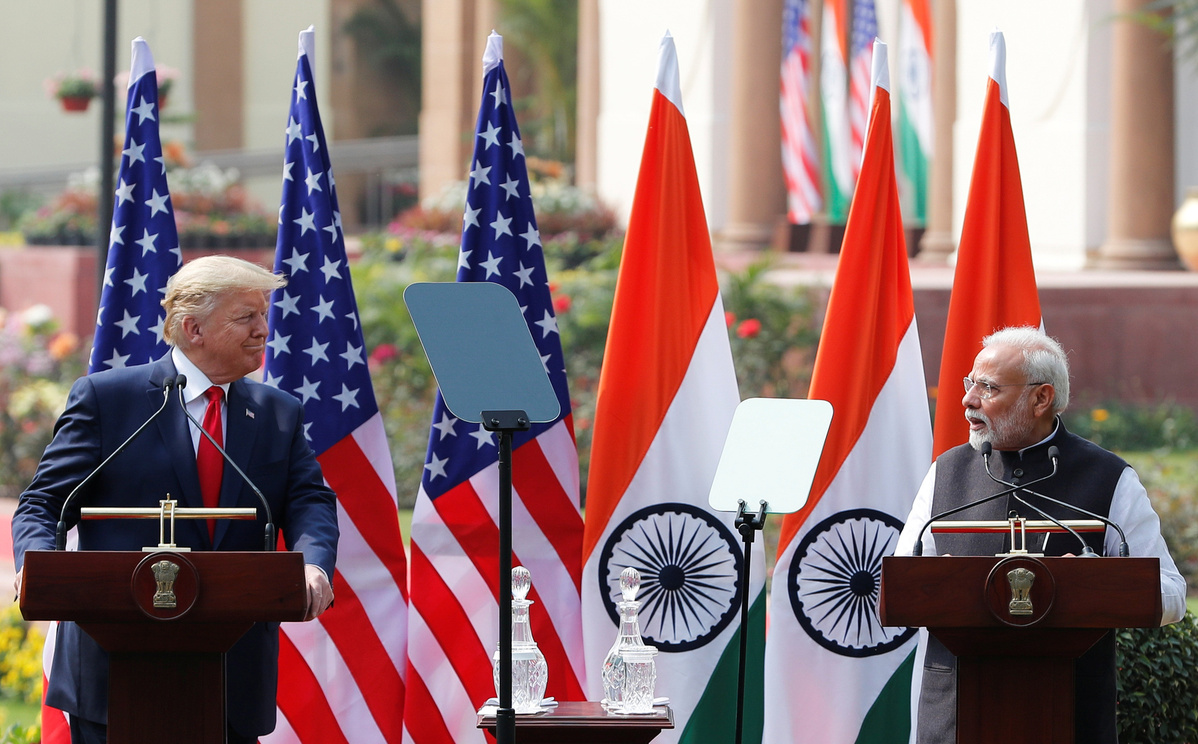
With memorandums of understanding worth more than $3 billion signed during US President Donald Trump’s just concluded 36-hour high-on-optics visit to India, India's defense acquisitions have crossed $20 billion for the last 10 years making military cooperation the defining pillar of the two countries’ “strategic partnership”. Trump’s visit also helped Indian Prime Minister Narendra Modi showcase that he is among the few world leaders who has a “personal chemistry” with the US president.
Under Modi, India has already signed two foundational agreements with the United States: Logistics Exchange Memorandum of Agreement in August 2016 and Communication Compatibility and Security Agreement in September 2018. And the Basic Exchange and Cooperation Agreement is expected to be inked soon, which will allow the US to sell to India all the advanced technologies that it shares with its NATO allies. Also, the US and India have already conducted the largest number of joint military exercises between any two countries.
But the rising tensions in their trade relations prevented the long awaited and much anticipated “l(fā)imited” trade deal – under negotiation for two years – from being signed during Trump’s visit. This, of course, is part of Trump’s global tariff blitzkrieg against all US “friends and foes” alike. Since his presidential campaign in 2016, Trump has been sermonizing how the whole world has been unfair to US and has taken advantage of it. China, which is the largest trading partner of the US, has experienced a similar rough ride.
As for India, it was in March 2018 that Trump invoked “national security” to impose additional 12 percent and 25 percent of tariffs on India's exports of aluminum and steel respectively. In June last year, India, along with half a dozen other rapidly developing countries, was removed from the list of nations under the US Generalized System of Preferences that provides concessions for imports from labor-intensive sectors in developing countries. This has hit about 12 percent of India's exports to the US with an additional $240 million of tariffs on goods worth $6 billion.
On the eve of Trump’s India visit, the US administration decided to categorize India as a “developed” nation based on India's total foreign trade being more than 0.5 percent of world trade, which is Trump’s premise to seek “reciprocity” in bilateral economic ties. Calling India the “tariff king”, Trump asked it to singularly lower its trade tariffs, and India has already reduced some of them.
The last three years have seen India’s trade surplus with the US coming down from $32 to $21 billion and for a “l(fā)imited” trade deal New Delhi had even agreed to import goods worth an additional $6.7 billion.
At the same time, just like China, India retaliated by raising tariffs on 28 items of imports from the US. But these are largely low-value commodities such as almonds, walnuts, apples, cashew nuts, chickpeas, peas, wheat, poultry and dairy products – and Harley Davidson motorbikes. India's 2020 annual budget presented earlier this month sought to protect its agricultural products, especially dairy and poultry with additional tariff and non-tariff measures.
But compared with China, the US’ exports to and trade deficit with India are minuscule. Still, there has been no let up in Trump's pressure tactics on New Delhi. Which is partly why India has sought to meet Trump’s demands by purchasing more defense equipment from the US.
This is also why India's newfound energy imports from the US promise to emerge as the second-most important pillar of their “global strategic partnership”. As the Indian minister for petroleum and natural gas recently said, India's imports from US of crude and gas that stood at $6.7 in 2019 are expected to cross $10 billion this year.
The US is India's sixth-largest supplier of energy, and India its fourth-largest destination for energy exports. During the “Howdy, Modi” event (a rally of tens of thousands of Indian-Americans) in Houston, Texas, last year, India had announced to invest $2.5 billion into the energy sector. India’s Petronet LNG Limited and the US’ Tellurian Inc have been finalizing its modalities. And the Nuclear Power Corporation of India Limited is now financially underwriting the bankrupt Westinghouse for procuring long awaited six nuclear power reactors promised after India and US signed a civil nuclear cooperation agreement in 2008. The two sides are also exploring opportunities for partnerships in clean energy technologies.
It is this hard economics that underwrites the two countries’ expanding strategic convergence in fighting terrorism and ensuring peace and stability in the “Indo-Pacific” region, and vocalizing high-octane platitudes while their operational strategies and priorities continue to vary widely.
The author is a professor at Jawaharlal Nehru University (New Delhi) and adjunct senior fellow the Charhar Institute (Beijing).
The opinions expressed here are those of the writer and do not represent the views of China Daily and China Daily website.





