India to continue its balancing act: China Daily editorial









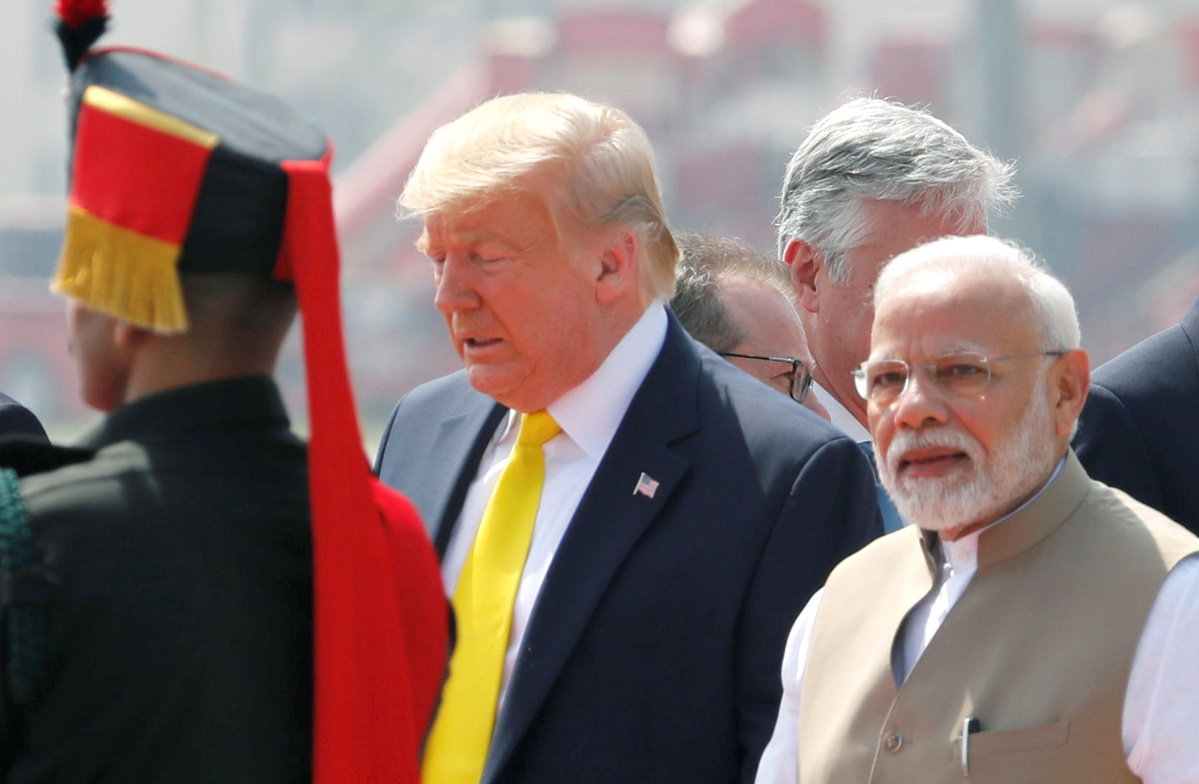
With even a modest US-India trade deal appearing elusive, the US president, who began a three-day visit to India on Monday, is expected to try and warm up bilateral ties with India.
Considering that this is the US leader's first visit to India since taking office, and he has visited many Asian countries since then, the US president may be hoping to address the previous strategic imbalance with New Delhi. Yet, even his newly found friendship with Indian Prime Minister Narendra Modi is no match to the high degree of attention his predecessor Barack Obama paid to India.
However, the two countries' mutual needs to shore up each other's economic and strategic agendas are driving this week's bonhomie.
After concluding trade deals with China, Canada and Mexico, the United States now eyes a similar agreement with India. For Trump, even a mini-trade deal with India, the world's fifth-largest economy with a population of 1.3 billion, could be a selling point for his reelection.
Modi on his part seems to be counting on his guest's support for his controversial decisions, including his revocation of autonomy for Muslim-majority Kashmir and the imposition of a security and communications lockdown, to help fence him off from the regional backlash against his policies.
However, despite their respective needs to enhance bilateral ties, much of India's strategic importance rests with the US administration's Indo-Pacific strategy. It will be no surprise if the US leader tries to use his India trip to persuade his host to jump on the bandwagon of the US' strategic maneuvering in the region.
Since the US president proposed his Indo-Pacific strategy to replace his predecessor's rebalancing to Asia policy in 2017, whether New Delhi will dance to the tune of the US has been the focus of global and regional attention.
But so far New Delhi has maintained strategic ambiguity which, in the final analysis, speaks of the South Asian giant's intention to strike a strategic balance with all major players in the region, including the US, China and Russia.
For New Delhi, such a strategic balance is a wise choice which would give it both strategic and diplomatic flexibility. Hence, India is unlikely to simply follow in the US' footsteps in the region.