



Getting the economy back up and running









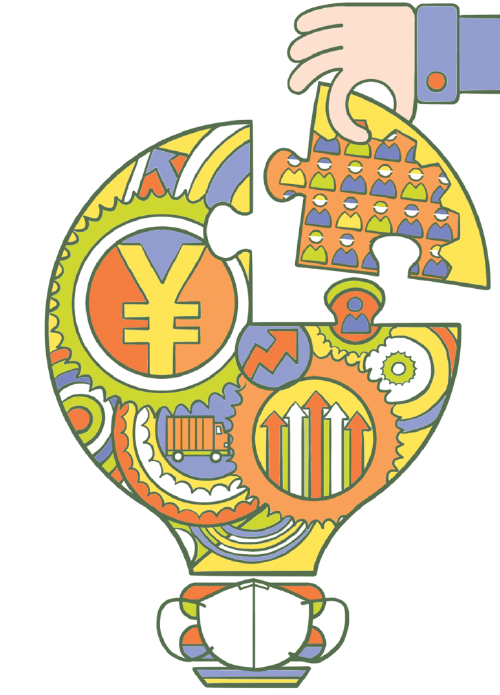
As long as policies are timely and accurately implemented, the momentum of economic development can be maintained
At present, the novel coronavirus outbreak has entered its second stage in China, that is, from the anxiety and panic of the first stage, to the current stage of resuming production while fighting the epidemic. China's central government and many local governments have issued numerous policies to support the resumption of production.
To understand and evaluate the impact of the epidemic on companies, the Institute of Sociology of the Chinese Academy of Social Sciences conducted an online survey at the beginning of the month and received 1,820 valid questionnaires. Based on the findings of this survey, we may be able to evaluate these policies from a micro perspective.
The policies issued by local governments have responded to the most important concerns of companies. The policies basically cover taxes, employment, finance and issues involved in work resumption.
Small and medium-sized enterprises are more likely to face financial difficulties. More than 40 percent of them hope that the government can provide financial services such as loans and bailouts.
The priority of the supply-side policy is still to support the cash flow of companies and then to restore logistics.
Some industries and enterprises have demands for stimulus policies. In general, 31.4 percent of the interviewed entrepreneurs are expecting stimulus policies, 25.05 percent the restoring of logistics channels, 14.16 percent the introduction of more online government services, and 8.71 percent expanded investment and more projects. However, 50 percent of online business-to-consumer companies are looking forward to the introduction of stimulus policies. Therefore, it is worth considering meeting the stimulus demands of some industries.
To promote economic development in the post-epidemic period, it will also be necessary to pay attention to demand-side policy tools. At present, many research teams have put forward policy suggestions from the perspective of the supply side, such as tax reductions, financial relief and the postponement of social welfare fund payments. We believe that it is necessary to adopt both supply-side policies and demand-side policies. Some monetary policies may be needed and we can take advantage of the internet financial platforms, carry out demand-side management of some commodities to curb unnecessary panic, and at the same time, specific consumption can enjoy preferential tax policies. In addition, for some industries that have been severely affected by the epidemic, especially the hospitality and catering industries, it is necessary to formulate policies to encourage public procurement and private consumption. Some past restrictions can be appropriately relaxed (such as raising the standard of official accommodation), and some unreasonable discrimination policies should be canceled. Rules and standards should be formulated to foster the business practices that have emerged during the epidemic, and promote innovative catering to demand side. After the adjustment of the central-local tax relationship, the policies of local governments to increase consumption are also very important for local finance.
Implementing targeted policies to arrange the resumption of work in an orderly manner. A current focus should be on evaluating the implementation of various policies that have been introduced, and timely overcoming the obstacles. Due to the restrictions of different government departments, the policy implementation still faces various inconveniences. Compared with small and large-sized enterprises, medium-sized enterprises have greater expectations that the government can accurately assess the risks of the epidemic spreading, and allow enterprises with low risk to resume work. The evaluation standards should be established as soon as possible.
To prevent the spread of the epidemic, workers can be transported back to factories under the organization of local governments and sent to concentrated quarantine spots before resuming work. It is worth noting that among the larger enterprises (301 to 1000 people), 24.39 percent expect the government to put more services online, the proportion of which is more than 10 percentage points higher than that of small and medium-sized enterprises. Companies in the financial industry and the agriculture, forestry, animal husbandry and fishery industries have a significantly higher demand for online public services than other industries.
It is necessary to pay attention to the physical and mental health of employees when they resume work, give full play to the role of social work and platform enterprises, and to establish epidemic prevention and management system. For the labor-intensive enterprises, many people are concerned about logistics and the resumption of upstream and downstream businesses. Besides, enterprises should also care about internal issues. For example, they should pay attention to the physical and mental health of employees. In the past, we did not attach much importance to corporate social work and shortcomings exist in this regard. Furthermore, for a long time, Chinese social work has not attached much importance to enterprises, nor has it paid attention to the social work infrastructure construction or coordination with enterprises. The supply of social work and the demand of enterprises cannot be effectively linked. But we have noticed that some local governments have cooperated with internet platform companies to provide a manual or a WeChat mini program for employees to ensure their physical and mental health and establish an epidemic prevention and management system on the cloud.
The epidemic has not affected the momentum of China's economic development. We need to take practical actions to alleviate the pessimistic atmosphere. Currently, we should focus on managing expectations, including judgments on when the epidemic will end and when normal logistics flow will resume. Then, attention should be given to financial problems related to cash flow, employee wages and loan repayments. Finally, we have to solve the long-existing problems. As long as the powerful policy is timely and accurately implemented, it is still possible to maintain the momentum of economic development and ensure that the economy runs smoothly in 2020.





