



“On-lookers” in novel coronavirus epidemic shall stop their calculations









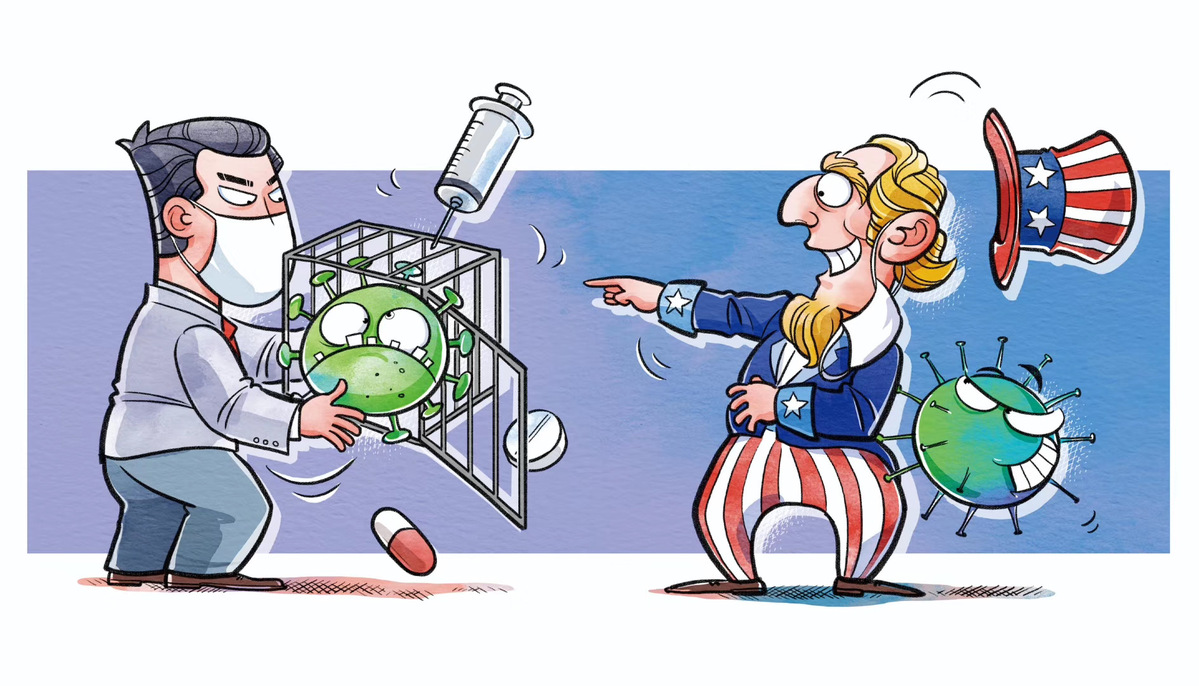
The unhealthy attitude of certain Americans amid the public health emergency of the novel coronavirus pneumonia is becoming more and more annoying for the international society.
A recent message posted on social media by Ho Ching, wife of Prime Minister Lee Hsien Loong of Singapore, drew wide public attention. Forwarding a report by US media that made irresponsible remarks on China’s political system, Ho questioned that “And what about the influenza B deaths in the USA?”
To contain the spread of the novel coronavirus as soon as possible, China has launched a people’s war against the epidemic, adopting the strictest and most thorough measures. Foreign governments and people across the world are also joining China’s efforts to combat the epidemic in different ways. The World Health Organization (WHO) and global public health experts contributed constructive suggestions.
However, some US politicians and media outlets have been making tart and even vicious remarks on China’s efforts to contain the epidemic. Their irresponsible attitude presented a sharp contrast with the global efforts to support China.
They acted as “on-lookers” who gloated over China’s misfortune. Some even took the “opportunity” to seek political gains, smelling blood in the epidemic regardless of their loss of morality.
The arrogance of these Americans is ridiculous, as if they had forgotten how their own country was coping with public health emergencies.
When the Zika virus spread over the American continent in 2016, the US was one of the major afflicted areas. The White House requested the Congress to allocate $1.9 billion in February, but encountered a party conflict which was quite “American Style”. Because of the dispute over legislation strategies, the allocation was postponed by 7 months, and only $1.1 billion was available, even though the Democrats and Republicans both understood the importance of the matter.
At that time, there were over 23,000 infections in the US and its Commonwealth Puerto Rico, including 2,000 women in pregnancy, the most vulnerable group to the virus. Besides, over 20 infants were found to have congenital defects because of the Zika virus.
The actions taken at the critical moment in the battle against epidemics are a mirror that reflects countries’ governance capability. National governance shall take people’s needs as a priority, and the government must spare no effort to meet people’s expectations. The delayed response of the US in the epidemic control caused by party conflict is by no means reasonable.
In 2009, when facing the influenza A (H1N1) virus, the US government first said there was no need for alarm, then suddenly declared it a national emergency, which many experts believed to be a misguidance for the world. As a result, the flu ended up spreading to 214 countries and regions.
What’s more, the US government also paid lip service in its promise to offer vaccines for the public. It promised to have 160 million doses of injectable vaccine on hand by October that year, but only less than 30 million doses had been prepared. According to a report issued later, the downsizing and expenditure cut of public health departments weakened the country’s prevention and control work of the flu.
Some people in the US can always wax lyrical when they point fingers at other countries, but turn their backs on the vulnerability of their own country’s system in coping with epidemics.
America is not a perfect country, just as many American public health experts stressed that the country is not ready for the challenges posed by major infectious diseases. Director of Harvard Global Health Institute Ashish Jha warned that epidemic is the most possible cause that can rapidly and accidentally kill millions of Americans, but also one that sees the least preparation.
Countries across the world should help each other and rely on complementary advantages in public health emergencies. The successful practices of a country may serve as a reference for others. American author Mario Cavolo recently published an article that compares the 2009 H1N1 virus in the US and the 2019 novel coronavirus in China on social media LinkedIn. He pointed out that it took six months for the US to declare a national emergency in 2009, and the death toll was vastly underestimated and updated not until three years later.
In the article, Cavolo said the forces attacking China’s efforts are bizarrely negative, and the world should be applauding China's unprecedented, broad and aggressive response.
When these Americans are trying to blame China’s endeavor in an arrogant and indifferent manner, what they really care about is not how to contain the epidemic in an early date or the lives of the people across the world. What’s in the mind of these “on-lookers” is indeed unpresentable calculations.
However, those who lost their sense of humanity can never prevail. To politicalize the epidemic and launch inhumane attacks will only destroy their own image.





