



Geely Auto, Volvo Cars team up in ambitious merger









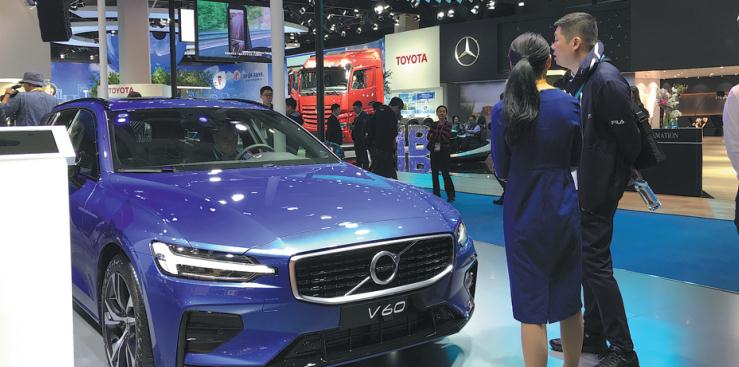
Move by the two companies expected to create China's most valuable carmaker
China's Geely Auto and Swedish brand Volvo Cars, both subsidiaries of Zhejiang Geely Holding Group, are planning to merge their businesses, a move that is expected to create the country's first truly global and most valuable carmaker.
The two companies said on Monday they will create a joint working group to prepare a proposal for their respective boards but did not give a specific schedule.
The merger would accelerate financial and technological synergies between the two companies and creates the scale, knowledge and resources for the business to become a leader in the ongoing transformation of the automotive industry, they said.
"A combination of the two companies would result in a strong global group," said Li Shufu, chairman of Zhejiang Geely Holding Group, in a statement on Monday.
He said the goal is to strengthen synergies while maintaining competitive advantages and the integrity of each individual brand.
After the merger, the new company will feature five brands: Volvo, Geely, Lynk & Co, Polestar and Geometry, covering affordable sedans to premium SUVs and electric vehicles.
The plants and sales networks of those brands in Europe, China and the United States will mark the emergence of China's first global carmaker.
Analysts at Bernstein said, "Strategically the deal feels like, after years of deal-making, a first move by Chairman Li Shufu to consolidate his sprawling automotive empire."
Li purchased Volvo from Ford in 2010. His holding group also owns London Electric Vehicle Co, a 49.9 percent stake in Malaysia's Proton, a majority stake in British sports car brand Lotus and a 9.7 percent stake in Mercedes-Benz parent Daimler.
BOCOM International, the securities and financial service arm of Bank of Communications, said the merger will help Geely and Volvo cut research and development costs on new powertrain systems and other technologies.
Last October, Volvo said it would merge its engine development and manufacturing assets with those of Geely, creating a division to supply Lotus, London Electric Vehicle Co, Lynk & Co and Proton, and also potential competitors with next-generation combustion and hybrid engines.
BOCOM International said the merger will also improve the image of Geely vehicles in international markets thanks to Volvo's reputation. The Swedish carmaker's network resources can facilitate brands, especially Lynk& Co, to make forays into European markets.
The two companies said the merged company will have access to the global capital market through the Hong Kong stock exchange and possibly in Stockholm as well.
It remains unclear how much value would be added to the Hong Kong-listed Geely by injecting Volvo assets. Following the announcement on Monday, its stock price rose 5.69 percent on Tuesday, with a total valuation of $19 billion.
Volvo and its parent group had been discussing an initial public offering to value the carmaker at between $16 billion and $30 billion before they dropped the listing plan in 2018, according to Reuters.
Yuan Xiaolin, senior vice-president of Volvo, said on social media that the merger will create a company that will top the list of Chinese carmakers in valuation. So far the No 1 is Shanghai-listed SAIC Motor, valued at $35.72 billion yuan.
He also expected the company to be one of the best-selling carmakers in the world. "One in every 30 vehicles sold globally will be from this new company," he said.
Geely's sales started to surge from 2015 as its products began incorporating Volvo technology. It sold 1.36 million cars in 2019, as the best-selling Chinese passenger carmaker for three years in a row, and aims to sell 1.4 million cars this year.
Volvo sold just over 700,000 cars last year, a record number in its 93-year history. Combined, the two sold 2.06 million vehicles, ranking 11th globally in 2019.




















