


After Zhu Yuanzhang (Emperor Hongwu), the first emperor of the Ming Dynasty, established the empire in Nanjing in 1368, toppling the Mongol Yuan Dynasty (1271-1368), he organized about one million laborers to construct his mighty city.
For the ongoing exhibition, some exhibits on loan from museums in Nanjing reflect that booming period. As the emperor's mausoleum in Nanjing has remained untouched, recent archaeological discoveries, all over the city, provide an intriguing glimpse of the lifestyle of high officials at the time.
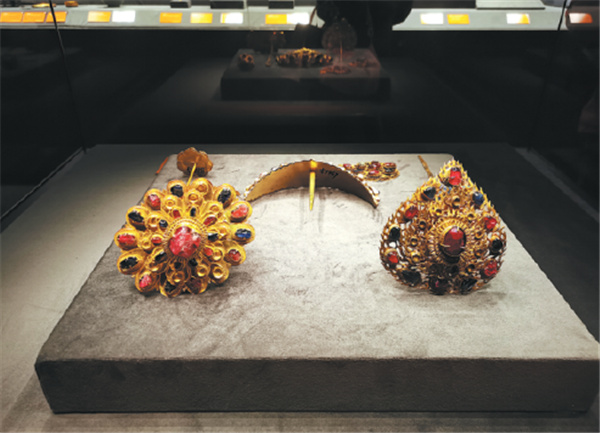
Findings from the glittering underground world-gold ingots, jewels and jade-portray the earliest days of a newborn empire.
Zhu Yuanzhang died in 1398, leaving the throne to his eldest grandson, Zhu Yunwen (Emperor Jianwen). The young ruler and Zhu Di, the founding emperor's fourth son, who was stationed in Beijing, soon found themselves in bitter dispute.
In 1399, Zhu Di rebelled and took Nanjing after a four-year civil war. The whereabouts of Emperor Jianwen has remained a mystery, and rumors said he escaped overseas. Some historians speculated that this was the reason why Zhu Di ordered the great mariner Zheng He to lead a giant fleet on overseas expeditions.
"And as the threat brought by Mongols was still imminent in the north, Zhu Di decided to move the capital north to better safeguard the frontline," Gao explains.
Zhu Di began his long project constructing a Forbidden City in Beijing. That 720,000-sq-meter compound is known as the Palace Museum today. It functioned as the imperial palace until 1912.
Through the exhibition, Gao reminds people "there was an even bigger Forbidden City" in Nanjing, which Zhu Di copied. That original compound, which was a royal palace until 1420, is believed to have covered more than one million square meters. However, it was gradually reduced to ruins by conflicts.
After the capital was moved to Beijing, Nanjing was still considered the "secondary capital" by the Ming Dynasty government. Nanjing Mandarin, which has tonal and pronunciation differences from today's Mandarin, based on the Beijing dialect, continued to be the official language throughout that dynasty.





