



Phase one deal brings a sigh of relief









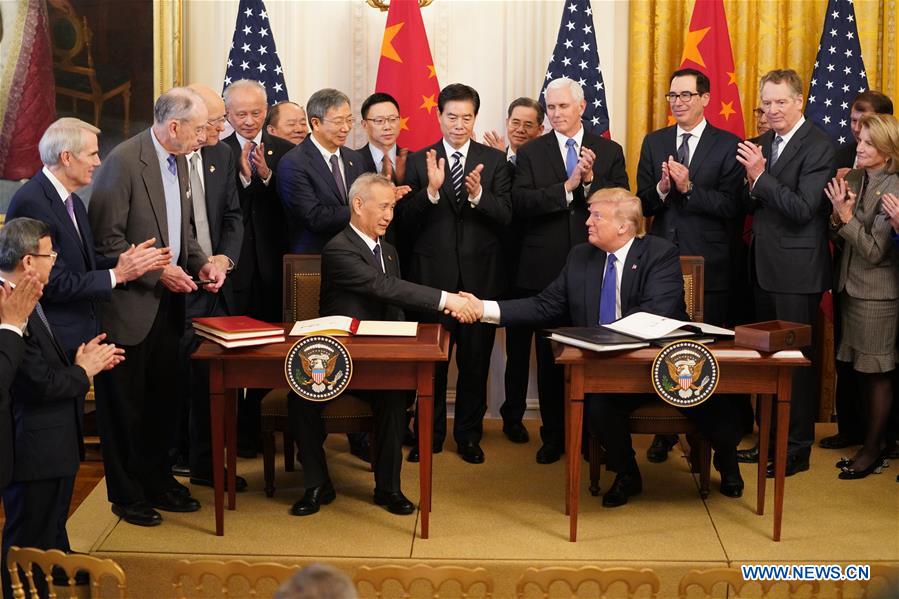
Editor's note: China and the United States signed the "phase one deal" in Washington on Wednesday after nearly two years' trade talks. It is expected to inject confidence into both economies, as well as the global economy. Two experts share their views on the issue with China Daily's Liu Jianna. Excerpts follow:
Reassuring agreement for both economies
The signing of the phase one deal is reassuring because it will reduce the uncertainties surrounding the China-US trade dispute which have dented investors' confidence and discouraged investment.
Due to the China-US trade war, some enterprises have taken precautionary measures by shifting their production units from China to other places, Southeast Asian countries in particular, to avoid the high tariffs the US has imposed on Chinese products, while some have rushed to export their products before the imposition of more tariffs as threatened by the US. The tit-for-tat between China and the US has not only upset the market but also proved to be a drag on global economic expectations.
That the two countries inked a deal on such tricky issues as intellectual property rights protection, market access, technological transfer and import of more US agricultural products by China is indeed a major positive development.
Yet the phase two trade negotiations are unlikely to be smooth, because the competition between the two countries' distinct development models, instead of the trade imbalance or so-called unfair trade practices, may dominate the talks.
The phase one deal seems mutually beneficial and, at least in the short term, enabled both China and the US to meet some of their goals. And the phase one deal is likely to create a relatively stable external environment for China, which will exert positive influence on the Chinese economy in the long run.
Given that Washington seems more eager than Beijing to sign the phase two deal, it should consider scrapping the tariff it has already imposed on $360 billion worth of Chinese goods, not least because the tariffs have also had a negative impact on the US economy, with American consumers and companies having to bear the brunt.
So, while the second phase negotiations progresses, China should intensify institutional reform and continue to open up the economy, as well as assess the risks and take measures to minimize them. Only by further strengthening its economy and boosting its comprehensive national power can China become more resilient to external challenges.
Zhang Monan, deputy director of and a research fellow at the Institute of European and American Studies, China Center for International Economic Exchanges
Pessimism over future Sino-US ties not justified
That China and the US have signed the phase one deal shows they can manage, if not altogether settle, their differences through negotiations based on equality and mutual respect. But we should not expect too much from the deal, as it was relatively easy for both sides to fruitfully conclude the phase one talks. By contrast, the issues likely to be discussed at the phase two negotiations would be much more difficult.
Judging by the White House's actions in the recent past, it could slap more tariffs on Chinese goods if the phase two negotiations don't proceed smoothly. Some of the thornier issues to be discussed at the phase two talks include so-called unfair subsidies for Chinese State-owned enterprises, bigger market access for foreign capital and further opening up of China's financial market.
But even if China-US trade relations stumble ahead, it is almost impossible to detach the two economies because they have become inseparable from the global industrial and value chains. And trade ties will remain the ballast of China-US relations.
As such, Sino-US trade relations should be carried forward along with the reform of the World Trade Organization. The new rules set for the WTO reform would guide the development of bilateral trade while the China-US trade dispute and the ways to manage it would provide examples for the rule-making process of the WTO.
There are concerns that bilateral ties could suffer in the year of US presidential election. But it was in the election year of 2000 that the Bill Clinton administration pushed the Congress to extend the Permanent Normal Trade Relations to China, and China joined the WTO in 2001. Therefore, China-bashing will not be a good card for US presidential candidates to play.
Tao Wenzhao is a researcher in US studies at the Chinese Academy of Social Sciences.
The views don't necessarily reflect those of China Daily.





