Winning a battle in war on poverty









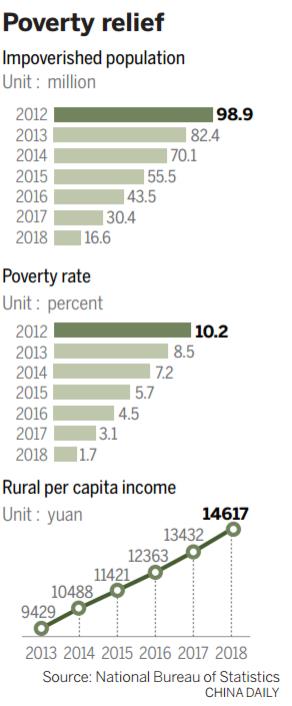
Targeted measures
China started tackling widespread rural poverty decades ago. In 1986, almost a decade after China decided to reform and open up its markets, Beijing created a cross-departmental office responsible for poverty reduction, which was the precursor of the State Council Leading Group Office of Poverty Alleviation and Development.
In 2000, the central government launched a landmark program to aid development in vast, poverty-stricken western regions. This in turn expanded much-needed infrastructure in the inland areas and instilled momentum for growth.
But many remained impoverished in rural areas due to varied reasons that could not be solved by a one-size-fits-all approach.
In 2013, President Xi Jinping proposed the idea of a targeted poverty alleviation plan for the first time during an inspection tour of Shibadong village in Hunan province.
Under the targeted relief campaign, officials are forbidden from merely handing out relief funds without finding ways of attaining sustainable incomes.
Instead, they were asked to carry out a thorough assessment of their resources, environmental conditions and culture, and draw up tailored, efficient relief plans.
The plans vary from village to village in some of the most remote areas, and may cover a range of ethnic groups.
In the vast but sparsely populated Tibet, mass relocation programs were widely adopted in an attempt to boost the incomes of herding communities and better provide public service.
Nyima, who now lives in the Sanyou village that is a one-hour drive from Lhasa, is among hundreds of Tibetans who have recently cast off poverty after participating in a mass relocation program.
For years, Nyima, who like many Tibetans goes by one name, had struggled to feed her extended family of six by rotating crops such as highland barley, wheat and tomato on a small patch of land in an impoverished community on the outskirts of Lhasa.
To bring in extra cash, her husband, who is an unskilled worker, had to seek temporary, poorly paid laboring jobs in nearby towns.
The family's plight was worse in summer when surging rainfall caused frequent flash floods in her village which sits in a ravine. The damaging torrents washed away bridges, disrupted farming and jeopardized the safety of her son and daughter, who both walked kilometers along a worn path to the nearest school.
"Those were hard days," said the 54-year-old Nyima.
In 2016, she applied for a place in a mass relocation program that targeted needy farmers near Lhasa. Her family was given a two-story Tibetan-style house near a train station bustling with travelers from across China.
There, her family runs a milk tea house, which helped her escape poverty in 2017. "My son was admitted to Xiamen University last year, and we all have great expectations for him," she said.






- Hubei deputy proposes museum of ancient Chinese law at Qin bamboo slip site
- Snow leopard captured after attacking skier, killing sheep in Xinjiang
- UK, Chinese universities join hands to tackle global health challenges
- Panda Health Train delivers free care to remote Sichuan prefecture
- Chinese scientists achieve breakthrough in quantum computing with 'Zhuangzi 2.0'
- University makes breakthrough in low-dimensional antiferromagnet research, paving way for R&D of new-generation chips