'Gross abuse of process'









The logo of China's tech giant Huawei. [Photo/Xinhua]
As more detailed evidence about the case of Meng Wanzhou emerged, experts called on Canada to respect the rule of law and correct errors in law enforcement procedures, saying that the arrest of Huawei's chief financial officer was purely politically driven.
Meng is facing extradition to the US for alleged bank fraud.
She was arrested at Vancouver International Airport by Canadian authorities at the request of the US on December 1, 2018, and has been held under house arrest since then.
Now detailed documents provided to the Global Times by sources close to the matter suggest that the arrest of Meng was a politically driven trap jointly colluded by the US Federal Bureau of Investigation (FBI), the Royal Canadian Mounted Police (RCMP) and Canada Border Services Agency (CBSA) that included abuse of law enforcement procedures and violations of the law for US political purposes: The border agency abused its inspection powers to conduct an illegal covert criminal investigation.
The documents show that CBSA staff arrested Meng on December 1 and sealed her phone in a mylar bag that blocked signals and forced her to give out the phone PIN code then transferred it to the police.
Routine border inspection does not include a probe of a subject's electronic equipment and the agency has no mylar bags which had been provided by RCMP.
Mounted Police work notes showed that the FBI had clearly brought up that Meng's electronic devices should be seized when she was arrested. Meng's lawyers question the way the Canadian authorities handled the case, as the CBSA forced Meng to give out her phone passwords and hand over serial numbers to the police.
Canada's border security agency has admitted this was an "error," according to a court document previously filed.
CBSA officers also questioned Meng for three hours, before the police executed a provisional warrant of arrest on December 1.
A few minutes before the three-hour questioning ended, Meng was forced to hand over passwords.
Experts say that her rights were infringed even before she was arrested.
"A person being arrested has the constitutional right to be promptly informed of the charges and to receive legal counsel in a timely manner." Yue Dongxiao, a US-based lawyer who is closely observing the lawsuit, told the Global Times on Tuesday.
"Meng accuses Canadian authorities of deceiving her into providing passwords to her electronic devices under the false pretense of a routine border check," he said.
"Such conduct infringed on Meng's fundamental rights, including her right to remain silent and right to counsel during custodial interrogation."
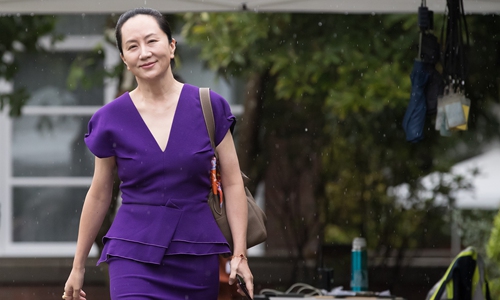
Huawei Chief Financial Officer Meng Wanzhou. [Photo/VCG]
Procedural flaws
The border agency court testimony contradicts the actual way Meng was treated at the airport, according to the documents.
An agency official later said the phone passwords were provided "in error" and could not be used as evidence. The official alleged neither the border agency nor Mounted Police checked the device's content.
However, according to the working notes of officials who enforced the law, the police sent phone identification information like serial numbers to the FBI.
In RCMP Sgt. Janice Vander Graaf's work notes for December 12, RCMP constable Dhaliwal told her that Ben Chang, another RCMP constable, had provided seized phone serial numbers to the FBI, but said she had no independent knowledge or recollection of the information provided during her conversation with Dhaliwal.
The Canadian police's denials that they shared phone information with the FBI have raised doubts.
The documents show that Meng's arrest at the airport constituted a gross abuse of process, during which the CBSA, RCMP, the Canadian Department of Justice and the FBI closely coordinated and cooperated.
Particularly during the process, Canadian Department of Justice officials and other high-level officials had been timely briefed.
Canadian police witnessed the whole process of arrest and search by border agents in violation of Canadian court orders, the documents showed.
Canadian law enforcement officials have an obligation to accurately document work notes, but the agency border inspectors, when recording notes, intentionally and "strategically missed the critical matters" without recording certain key sensitive facts, according to the documents.
For example, the agency missed out the fact that the agency communicated with US authorities, that the agency and police met on December 1, and the arrest plan was changed.
The agency also missed out the fact that the agents wrote down phone passwords on a separate note and asked Meng questions concerning criminal charges in the US.
- See the difference in latest Huawei controversy
- Washington continues witch hunt against its bugbear Huawei: China Daily editorial
- Huawei ex-employee case needs proper solution
- US has trouble stigmatizing Huawei as there are no grounds for it to do so: China Daily editorial
- Trump's 'xenophobia' against China, Chinese students and Huawei