



India's hesitation will not delay RCEP









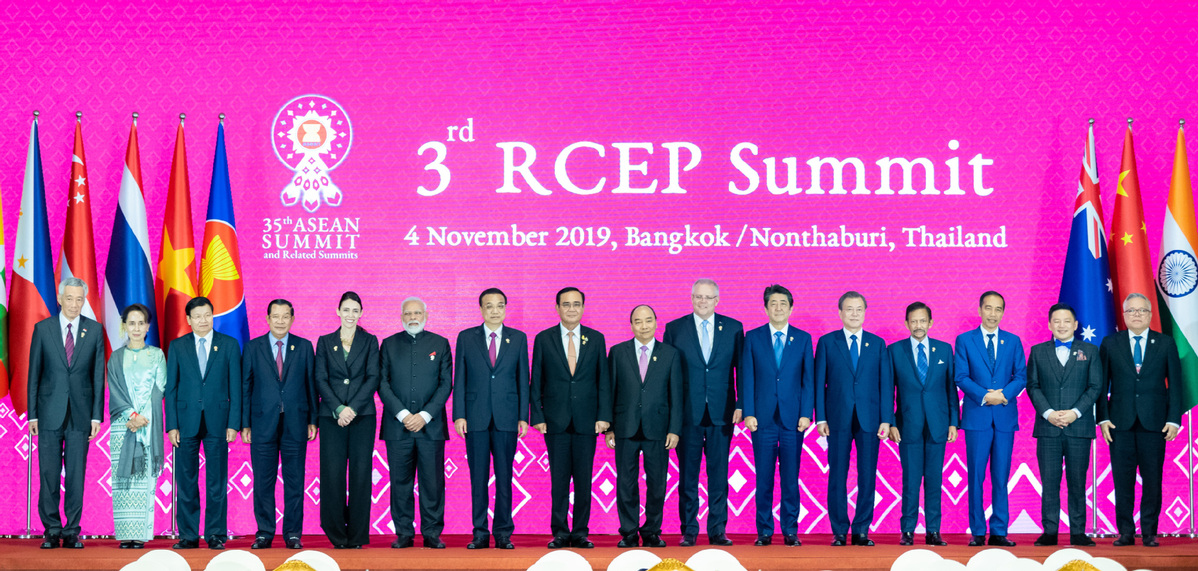
Editor's Note: The third Regional Comprehensive Economic Partnership leaders' meeting held in Bangkok, Thailand, on Nov 4 issued a joint statement announcing that the members of the Association of Southeast Asian Nations and ASEAN's six FTA partners-Australia, China, India, Japan, New Zealand and South Korea-had concluded negotiations on substantial issues and planned to sign an agreement by 2020. 21st Century Business Herald comments:
Shortly after the announcement, Indian Prime Minister Narendra Modi decided to delay signing the agreement until "important issues" were resolved. India's "wobbling" not only casts a shadow over the RCEP's future, but has also caused an "ambiguous" attitude in Japan.
According to the 2018 data, the 15 member states of the RCEP, excluding India, have a population of 2.2 billion, a combined GDP of about $29 trillion, exports of $5.6 trillion, and a foreign investment flow of about $370 billion. With both the population and the economic size accounting for about one-third of the world's total, the RCEP, when completed, will be the world's largest regional trade agreement.
Now 15 countries have completed negotiations on the RCEP and will sign the agreement in 2020 as planned. For now, the uncertainty about the future of the RCEP mainly comes from India which is concerned that its inadequate emergency import restrictions to prevent a sharp increase in imports and a widening trade deficit would have a negative impact on its domestic industries.
If India does not join the RCEP, it may create uncertainty about Japan's participation. Following India's decision to suspend the signing of the RCEP agreement, Japan's ministry of economy, trade and industry has repeatedly stressed the need to sign a 16-nation pact that includes India, saying a RCEP including India is crucial for Japan. At the same time, Japan and the United States have reached a preliminary agreement on a free trade area and jointly put forward the concept of a "free and open Indo-Pacific", hoping India can join and jointly lead economic cooperation and rules-making in the region.
If India does not sign the RCEP agreement for the time being, the population and trade volume covered by RCEP will decrease by 37 percent and about 7 percent respectively. However, considering its previously positive attitude and its belief that the RCEP will enhance its economic and strategic strength, India's latest stance is likely a negotiating ploy to secure preferential treatment for it.
Even if India does not participate temporarily, the other economies should sign the agreement on time. China is a firm promoter of the RCEP, which will set an example and model for promoting regional trade liberalization and global economic integration, and benefit China's economic and trade development and help China build a "circle of friends" in the Asia-Pacific region.





