


Zhang Xiping, a renowned professor at the Beijing Foreign Studies University, whose research covers Chinese philosophies and religions in China, said: "The merging of Buddhism, Confucianism and Taoism became irreversible during the Ming Dynasty in the 14th century. Shying away from answering questions about life and death, Confucianism offers guidance for behaving and self-cultivation but not comfort to the soul. But those questions had to be answered and the soul comforted. That was where Buddhism and Taoism, the latter concerning itself with immortality, came in, together giving rise to Chan, or Zen Buddhism."
"Since they dealt with different realms - this life and the next - these different ways of thinking complement rather than contradict each other. This also explains why in Chinese history, no war has ever been fought in the name of religion," he continued.
This meditative inclusiveness is reflected in art: a large hanging scroll from the early 17th century teems with Buddhist and non-Buddhist immortals, each with power that the artist hoped to invoke.
Right at the center, sitting cross-legged on an open lotus, is Guanyin, the Goddess of Mercy known outside China as Bodhisattva. Guanyin, famously cast as the female disciple of the Buddha in the 16th century Chinese novel Journey to the West, is without doubt the most venerated deity in ancient China, helping women in the fulfillment of their maternal duty, by bringing them an offspring.
In a potent example of what happens when a ruler became a devout Buddhist, Empress Dowager Cisheng of the Ming Dynasty commissioned her own incarnation of the all-compassionate Guanyin, accompanied by a child deity who appears on the lower left side of the painting and who is almost certainly the empress' elder son, Emperor Wanli.
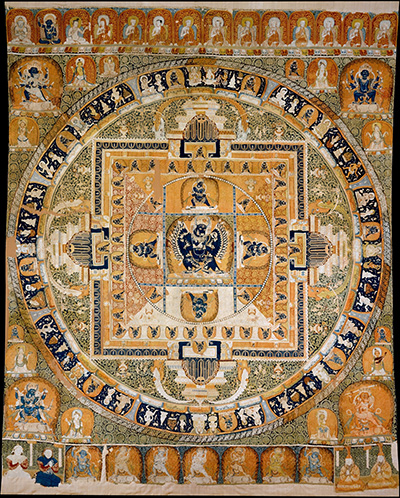
Politics and religion were inextricably intertwined, something of which the exhibition has plenty of proof. A small alcove linked to one of the galleries is occupied on three walls by three hangings, all dedicated to Tibetan Buddhism but belonging to the consecutive periods of China's Yuan, Ming and Qing dynasties (1271-1911).





