


Landmark study indicates Semenya has advantage









IAAF says research justifies decision to bar Olympic champ
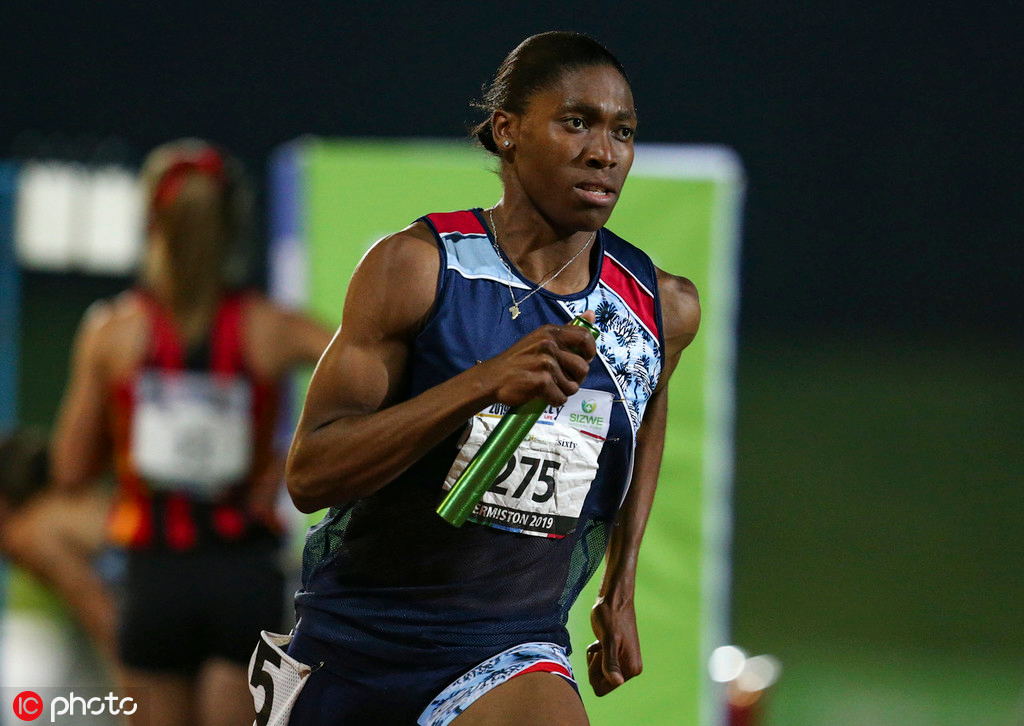
LONDON - The governing body of world athletics on Wednesday welcomed the results of a new study showing high testosterone helps women run better, saying it justifies the decision to bar Olympic champion Caster Semenya from key races.
In a study published in the British Journal of Sports Medicine, Swedish researchers found women with higher testosterone can run longer and have more lean muscle mass.
The International Association of Athletics Federations (IAAF) is embracing the study as proof it did the right thing in barring South Africa's Semenya for high levels of testosterone, which primarily a male hormone.
"The IAAF introduced a testosterone limit for the female category for the sole purpose of maintaining fair and meaningful competition for women," the IAAF said in a statement, adding: "The study reinforces our evidencebased conclusion that high testosterone levels give female athletes a significant advantage in some athletic events."
Medical professionals had believed that testosterone fueled strength and endurance in men, but the benefits for female athletes were previously unclear.
No longer, according to the researchers from Karolinska Institutet in Sweden.
"Our study supports a causal effect of testosterone on physical performance, as measured by running time to exhaustion, in young healthy women," said the researchers, whose study was released on Tuesday.
There was no immediate reaction from Semenya, whose ban from the women's 800-meter race at September's World Athletics Championships in Qatar sparked controversy in and outside of sport.
Her case became a test of where sports authorities draw the line when it comes to athletes whose bodies fall outside standard ranges or who change gender.
Medical condition
A 28-year-old double Olympic champion, Semenya has a medical condition called hyperandrogenism, which boosts her testosterone count.
She has steadfastly refused to take hormone suppressing medication to comply with the regulations.
The hormone limitation was initially imposed earlier this year for intersex athletes whose bodies do not fit the usual expectations of male and female at birth, drawing condemnation from the United Nations.
On Tuesday in Qatar, the IAAF revamped the rule to add transgender competitors to the list of restricted athletes.
It had based its ban on evidence that it had partly funded and which drew criticism after scholars from the University of Colorado said they could not replicate the study and found 17 to 32 percent of the data used was wrong.
The Swedish study was conducted on 48 physically active women aged 18-35, with some randomly chosen to take a testosterone cream and others to take a placebo over 10 weeks.
Researchers tested the women by measuring their running time to exhaustion, as well as their performance on a stationary bicycle and muscle strength during squats and other exercises.
Scientists found the women in both groups had gains after the experiment, but those with higher testosterone chalked up better results, lasting 21.17 seconds longer than before and gaining 923 grams of lean muscle mass with their weight unchanged.
Lean muscle mass allows for greater speed, strength and endurance.
Emma O'Donnell, a lecturer in exercise physiology at Loughborough University, questioned if the study might impact LGBT+ communities and other athletes.
"These study findings also bring into question whether having a cutoff value for testosterone is a good thing.
"Might it encourage female athletes to take testosterone?" O'Donnell wrote in an email on Wednesday.
The study's authors, who were not immediately available for further comment, said their results were "of great importance" to the discussion around Semenya's condition.
Earlier this year, the Court of Attribution for Sport said while the testosterone regulation was discriminatory, it was "necessary, reasonable and proportionate" to protect "the integrity of female athletics".
Reuters


Most Popular
- China's Wang extends winning run, teenager Jiang makes breakthrough
- SERVING AS AN INSPIRATION
- Ahead of Asian Games, Japan takes firm stance over online abuse
- Gap narrows between NCAA and MLB
- Antonelli chases hat-trick, as F1 season revs back up
- Pioneer Pichardo reluctant to steal team's spotlight