


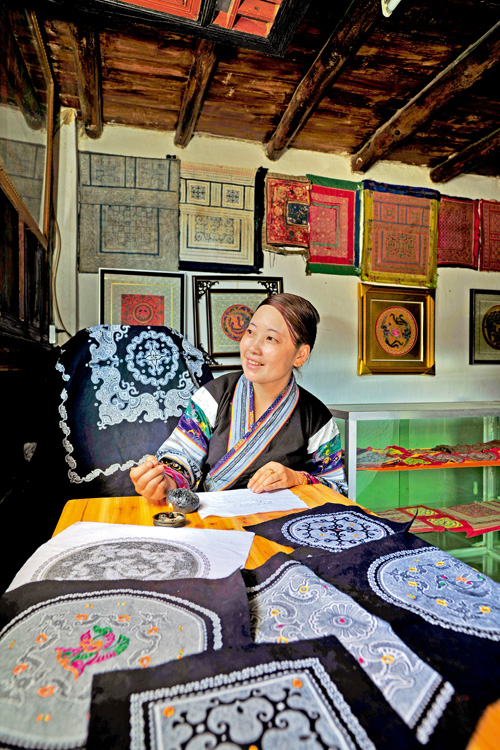
Batik, also known as resist-print dyeing, dates back more than 2,000 years. Resist printing is a method used to apply a design on a fabric. It requires the covering of parts of the fabric in a way that will prevent the dye from penetrating the material. The cover may be a variety of materials. Other than flat-bed silk screening and rotary silk screening, resist-printing processes are completed by hand. Wax is used in batik, while string or rubber bands are used in the tie-dye process. Many Miao villages in Central China's Hunan and Southwest China's Guizhou, Yunnan and Sichuan provinces have long been known for their top-quality batik works (including clothing, bedding, handbags and paintings). With white, true-to-life patterns of flowers, animals, plants and landscapes on an indigo background, the exquisite artworks embody the ethnic group's traditional cultural elements. The Miaos' batik craft was added to China's list of intangible cultural heritage in 2006.
Creating Miao's Batik Works
Batik, which originated during the Han Dynasty (206 BC-220 AD), resulted from the wisdom of Chinese craftsmen and craftswomen. Batik is a technique of resist-print dyeing applied to a whole cloth. Batik is made either by using crayons to draw patterns on the cloth, or by dipping melted wax on the cloth to form various patterns. The applied wax resists the dyes and therefore allows artisans to color the material selectively by soaking the cloth in one color, removing the wax with boiling water, and repeating if multiple colors are desired.
According to legend, a young woman, who lived in a Miao village, pondered ways to dye various flower patterns on cloth. One day, she dozed off while she was looking at flowers. In a dream, a fairy maiden led her to a big garden. Fascinated by the beautiful flowers, the young woman did not realize many bees had rested on her floral-patterned skirt. When she woke up, the woman discovered the beeswax marks on her skirt. She tried to remove the marks by dyeing her skirt indigo. To her surprise, the marks turned into white flowers after she washed her skirt with boiling water.
Enlightened by her finding, the young woman invented the technique of resist-print dyeing. She also taught the villagers how to use beeswax to make patterns on their clothes.





