



New forests help battle sandstorms









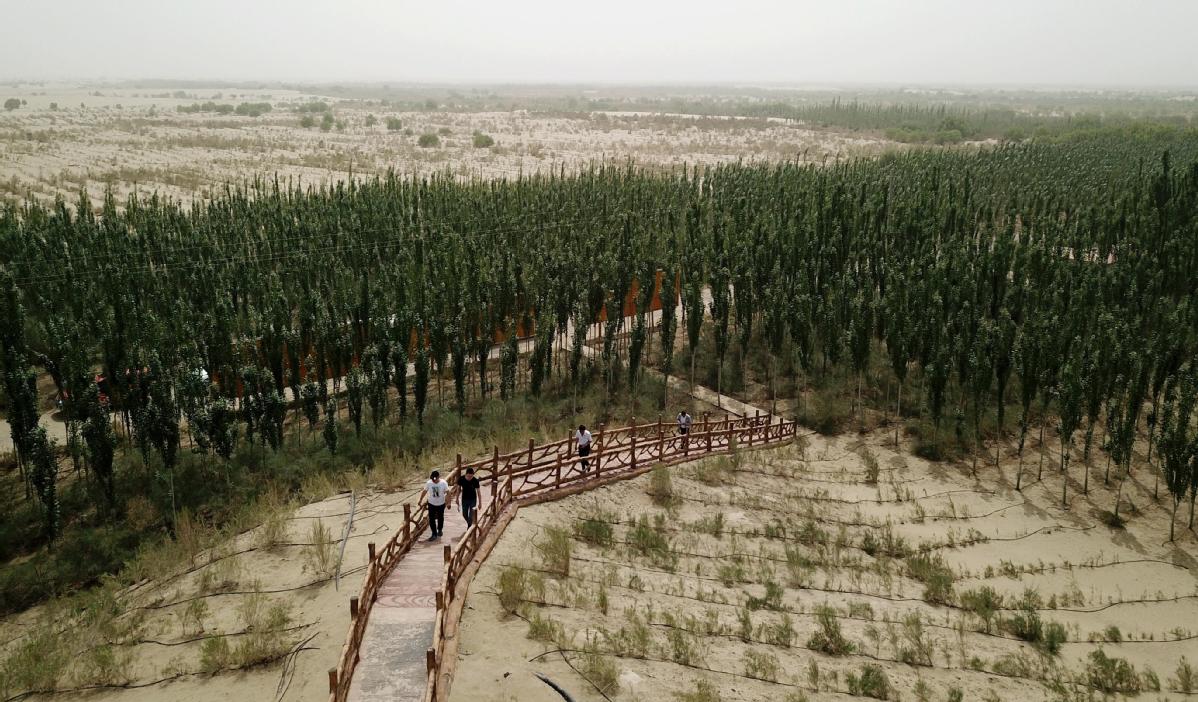
Disastrous sandstorms are familiar to 77-year-old Abula Amat, who lives in Makit county in the Xinjiang Uygur autonomous region.
"Before I was 18 years old, my family had relocated at least four times due to the storms. A severe sandstorm would bury half of our house, leaving the pots and bowls in the kitchen full of sand," he said.
A river once ran through the village, he said, but the river channel changed several times due to the sandstorms.
"Both villagers and livestock severely lacked water and we were forced to move from one place to another," said Abula Amat.
Makit is in the eastern part of Kashgar prefecture on the southwestern edge of the Taklimakan Desert, one of the largest deserts in the world, spanning more than 1,000 kilometers across southern Xinjiang.
The county's environment is very fragile, with 90 percent of its area desert.
In 2012, a government-led project was launched to plant forests, aiming to bringing more green to the sand-hit region.
Efforts from residents and the forestry department have led to the planting of 20,000 hectares of forests comprised of saxaul and poplar-two drought-resistant trees whose roots bind the sand and prevent invasive sandstorms.
According to local meteorological authorities, Makit saw 100 millimeters of rainfall in 2018, compared with only half that amount a decade ago. Meanwhile, sandstorms only occur about 50 days a year, from about 150 in 2009.
In addition to combating desertification, the greening project has also contributed to the fight against poverty.
According to the local forestry department, 230 residents from poor households were hired as forest rangers, each earning a monthly salary of 4,000 yuan ($560).
The greenbelt keeps out the wind and sand, as well as providing people the opportunity to plant some traditional Chinese herbs, such as cistanche, or desert broomrape, which they can sell.
In 2016, the county built a cistanche production center covering 1,330 hectares.
Last year, the production of cistanche brought local farmers an income of 40 million yuan, according to Amat Mamat, the secretary of the desertification department at the county's forestry bureau.
"I am so happy to see the current achievement," said Amat Mamat proudly. "Years ago, the county was so hot and seldom received rain. People saw a thick layer of dust almost every morning when they woke up. But now it rains a lot. Our efforts to control desertification have been rewarded."


- Chinese 'self-media' accounts penalized for misleading publishing
- Tourists flock to Hainan for May Day holiday
- A Date with Shandong: Weifang, the city painting the sky
- Liuzhou incident leaves 4 dead, 1 injured; investigation underway
- Communist Youth League of China has nearly 78.34 million members
- Niche tourism steals spotlight in China's bustling May Day holiday travel season





