



The most important healthcare tool is trust









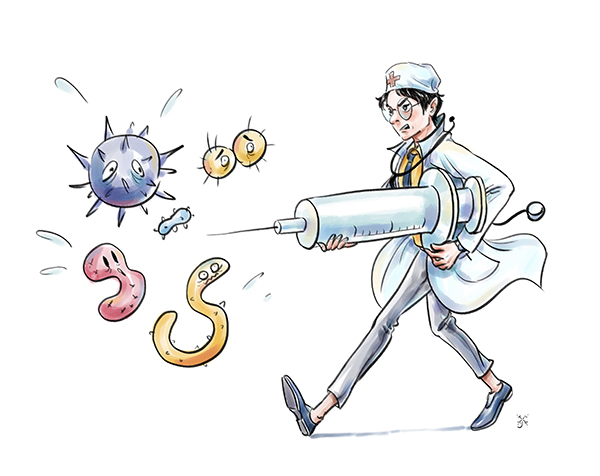
Doctors and nurses have traditionally been among the most trusted people in society. According to the Wellcome Global Monitor, the largest-ever survey of public attitudes toward science and health, that remains true: more than 70 percent of those who responded to the survey said they trust scientists, doctors and nurses. But their responses also indicated there is no room for complacency.
Half of the 149,000 respondents from more than 140 countries said they know little or nothing about science, and almost one in five doesn't think that it benefits them personally. This lack of engagement with science raises serious-even life-threatening-risks.
Consider attitudes toward vaccines. Globally, the vast majority of people recognize that vaccines are safe, effective and necessary. But in some wealthy countries, the share of people who trust vaccines is plummeting. In France, for example, 33 percent of the people do not believe vaccines are safe and effective.
The impact of vaccines depends on herd immunity: the protection of communities, including people who cannot be immunized for reasons such as illness or age, by vaccinating most of their members. While most children in France still receive the measles vaccine, there are areas where immunization rates have fallen below the herd-immunity threshold of about 95 percent.
The results have been devastating. The number of measles cases reported in France increased sixfold in 2018: three people died, and many more were left with life-altering health problems. Falling immunization rates in some areas of the United States and the Philippines also led to measles epidemics in those countries in 2018 and 2019.
Education undoubtedly plays a role in shaping attitudes toward vaccines, but so do myriad personal, social, religious and cultural factors-and, most fundamentally, trust. And when faith is depleted, the consequences are typically disastrous.
The Democratic Republic of the Congo is a case in point. Decades of war, insecurity, and neglect have decimated trust in institutions across the east of the country. So, when an Ebola epidemic broke out in August last year, those charged with implementing the response-including government officials, international health agencies, and even local community health workers-were met with deep suspicion, even hostility. Treatment centers were attacked, leaving health workers dead or injured. The epidemic's death toll has continued to rise in the meantime.
To prevent the Ebola outbreak from intensifying, the relevant actors-from health workers to government officials-must re-engage with the affected communities and win back their trust. And as neighboring Rwanda has proven, this is possible.
In 1994, Rwanda endured a brutal genocide, in which an estimated 800,000 people were killed in the space of just 100 days. This harrowing experience left behind destroyed property, and a traumatized population with little faith in local or international institutions. National basic immunization coverage was less than 30 percent.
But, in the ensuing years, government and international partners engaged actively with local communities, in order to rebuild trust. Their efforts worked: Wellcome Global Monitor shows 99 percent of the people in Rwanda now recognize vaccines are effective and important, and 97 percent have confidence in their healthcare system overall-more than in any other country. This has enabled significant progress on health. Basic immunization coverage is now up to 95 percent. In 2010, Rwanda became the first African country to introduce a program focused on reducing the risk of cervical cancer-the most common cancer among Rwandan women-by providing the vaccine against human papillomavirus. And the government aims to prevent cervical cancer deaths in the next few decades.
Public-health outcomes such as the one in Rwanda cannot be achieved without trust. No matter how exciting the treatment, how clever the delivery method, or how robust the science, there will be no impact unless the local community is open to it.
One survey cannot explain why people feel the way they do, let alone offer a foolproof strategy for governments, international institutions, and healthcare professionals seeking to win people's trust. But, as the world faces profound science-related challenges-from climate change to antimicrobial resistance-policymakers, practitioners and civic leaders would do well to learn as much as possible from the Wellcome Global Monitor's invaluable data.
The author is director of Wellcome Trust.
Project Syndicate
The views don't necessarily reflect those of China Daily.





