


Autistic Children warm to Canine companions










Basic qualities
Tao, from the Nanjing Mingxin center, said: "We tried AAT once before we got in touch with Wu. A teacher at the center had a Golden Retriever and arranged for it to spend time with our autistic children. Although the children liked the dog, the animal was frightened and did not cooperate. We had to drop the plan due to safety concerns."
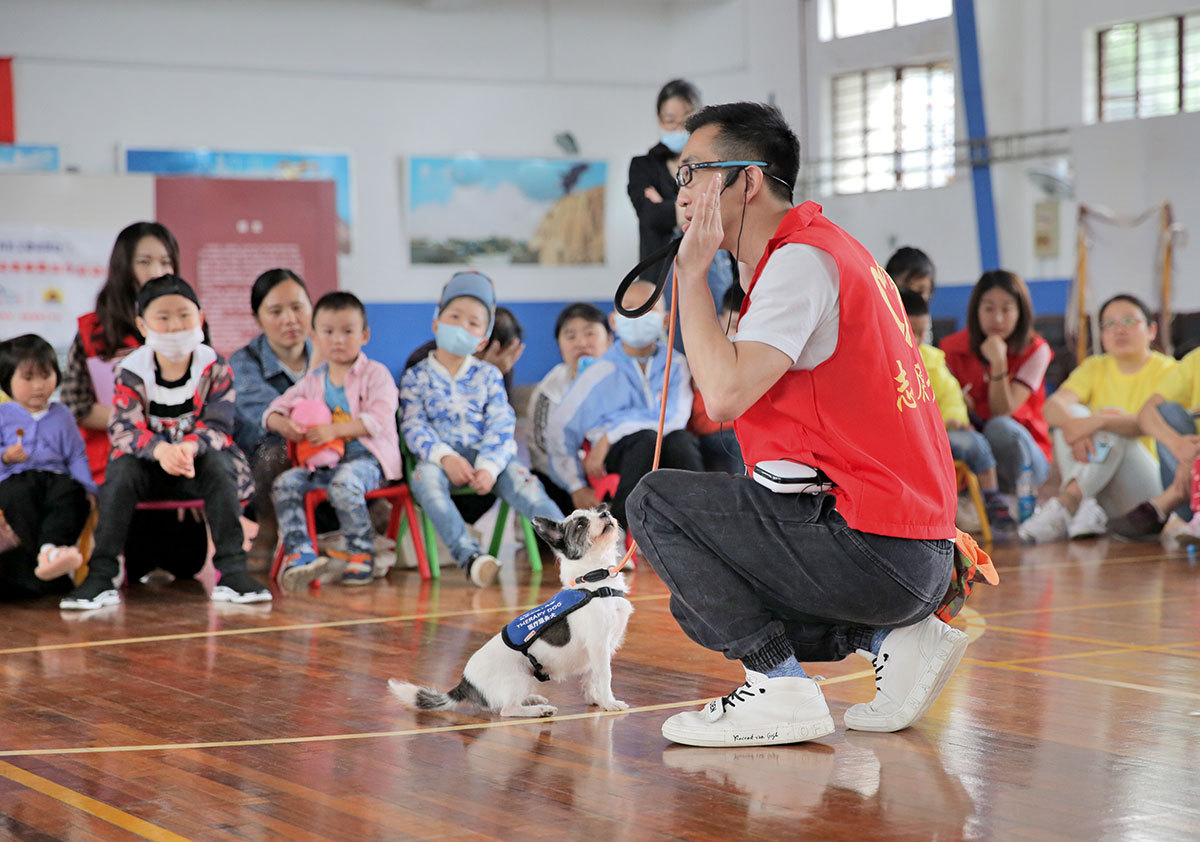
Wu said this example illustrates the difference between ordinary pets and trained AAT animals. "Not all dogs can become AAT animals. They should have some basic qualities, including a mild temperament, the desire to interact with people, and the willingness to receive training," he said.
Dogs with these qualities must receive systematic training to avoid becoming overly sensitive to the environment, and it usually takes one year for a dog to become a qualified AAT animal.
Such training costs more than 100,000 yuan ($14,530), and not all the dogs that receive it can become qualified AAT animals.
Wu once had more than 50 dogs and 30 trainers, because the high cost and the energy required forced him to find alternative ways to publicize the therapy, instead of doing it all by himself.
"I decided to share my training techniques with more people to publicize AAT," he said. "I also invited more volunteers to participate in the therapy. Now, we have groups in large cities such as Beijing, Shanghai, Nanjing and Hangzhou (capital of Zhejiang).
"Our goal is to establish 10 volunteer groups in China. Meanwhile, we have strict criteria for choosing the volunteers and their dogs.
"I think that developing volunteers and inviting more families to take part in the therapy is the right way to develop AAT in China."
Tao said, "There is almost no AAT research in China," adding that she wants to compile a book with Wu to introduce the therapy to more families. "It should be known by and benefit more people in need," she said.
In addition to helping autistic children and Alzheimer's patients, Wu and his team offer assistance to some physically and mentally challenged people. They also take part in a children's palliative treatment program at Children's Hospital of Soochow University in Jiangsu.
Wu is attempting to contact more universities and institutions overseas, and said the University of Edinburgh in Scotland has been in touch with him about introducing advanced AAT to China. This program will be launched in September.
Guo Jun contributed to this story.





