



Thirty two years watching the evolution of China









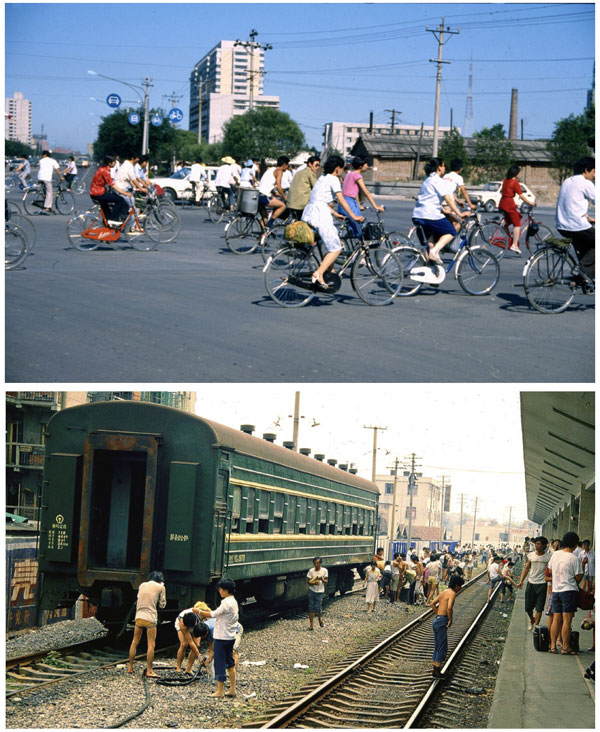
But to return to the most common question: of course China has changed vastly since 1987. I could never have imagined then, as my train steadily pulled away, that twenty years later the country would be embarking on creating the world’s greatest, most extensive high-speed rail system.
Beijing to Tianjin started with 350 km/h services in 2008, in time for the 29th Olympics. Steam locomotives still operated and were being manufactured in China through into the 1990s.
Admittedly, I loved my steam rail adventures in Guangdong and still talk of them. However, much of the early rail services were operated manually, making them incredibly labour intensive. Today, the technological advances mean increasingly advanced computer systems enable sixteen-coach units to travel safely not only at high-speed, but with only a few minutes between each train.
I regularly pass through Beijing South Railway Station, and constantly see new high-tech developments making travel both easier and more efficient. Electronic departure boards display a seemingly endless list of trains departing every five or ten minutes to nearby Tianjin or Shanghai. Stations today bear no resemblance to those I experienced in the late 1980s and ’90s. But they had been constructed for a different period in China, when far fewer people travel compared to today (although I admit that for an avid traveller such as myself, some of the earlier adventures of travel have slowly been replaced with the rapid rush towards even better levels of technology!)
In 1987, Beijing was a city of the bicycle. At my hotel in Beijing’s Haidian District, phoning back to Scotland required placing a request with the hotel operator to make a call at a certain time. I would eventually be called back with a connection through to my parents who would be wondering where I was. Today, of course, smartphone technology allows us to quickly organise multi-trip, multi-transport journeys to China or beyond quickly and efficiently. I hardly ever use cash, since my phone acts as a digital wallet and keeps fumbling around for coins or banknotes at its awkward distance.
Travelling south by rail through China was both an adventure but also a learning experience.
Following the same route today, I was once in a different country. China was much more agricultural when I first took the journey, with many people working the land. Most urban areas we passed through were much smaller by comparison, but again relied mainly on intermediate technology. The urban streets and rural roads were certainly much quieter, and along the entire route, there wasn’t an expressway in sight. I noticed most places seemed to have very little evening activity; the bright electronic lights of today were not there, let alone the high buildings that we now accept as the norm.





