Trump gives farmers $16 billion in aid









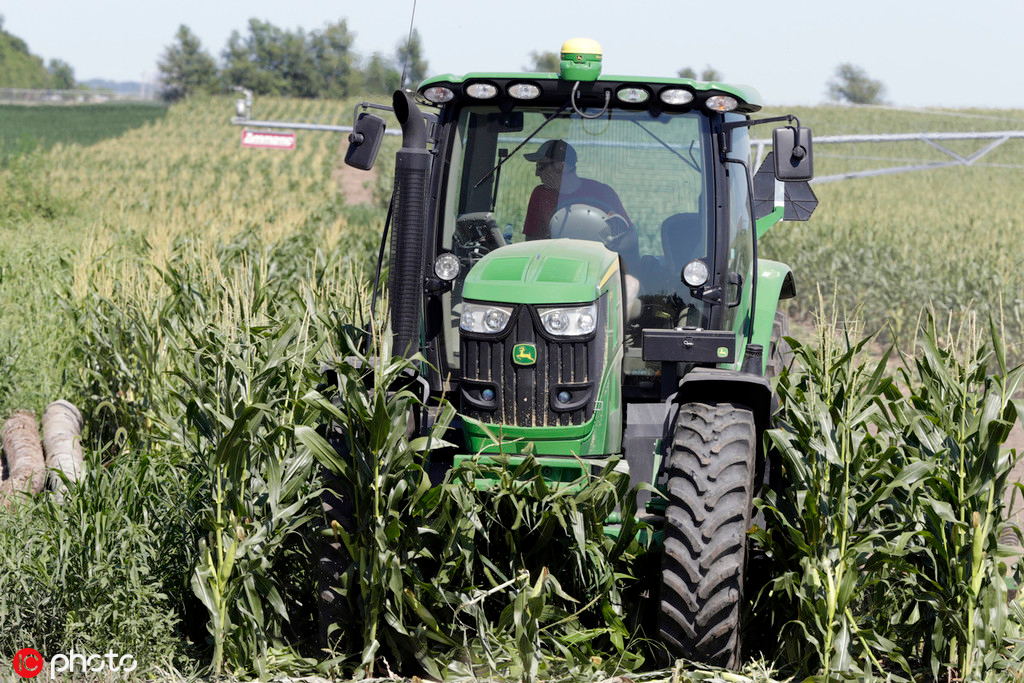
American farmers, a key voting block in US President Donald Trump's unexpected victory in the 2016 election and among the hardest hit by the ongoing US-China trade dispute, will receive $16 billion in aid, the Agriculture Department announced on Thursday.
Later on Thursday, Trump predicted a swift end to the ongoing trade war with China, Reuters reported.
Although no high-level talks have been scheduled between the two countries since the last round of negotiations ended in Washington two weeks ago, Trump said: "It's happening, it's happening fast and I think things probably are going to happen with China fast because I cannot imagine that they can be thrilled with thousands of companies leaving their shores for other places."
The $16 billion aid package "is in line with the estimated impacts of unjustified retaliatory tariffs on US agricultural goods and other trade disruptions," the department said in a statement, and follows $12 billion authorized last year.
"Farmers themselves will tell you they'd rather have trade than aid," Agriculture Secretary Sonny Perdue told reporters in a briefing. "The package we're announcing today will ensure that farmers will not bear the brunt of those trade actions."
Perdue said the first of three payments is likely to be made in July or August and noted a new trade agreement with China could be reached prior to the first payment.
In the 2018 aid program, farmers received different payments for different crops.
This year payments will be based on the Agriculture Department's estimate of economic damage sustained by each county in farm states. This means payments are likely to differ by county within each state and will be based on the number of acres planted rather than specific crops.
The Agriculture department allocated about $9.4 billion of the $12 billion approved for the 2018 program, including $8.52 billion in direct payments to farmers. Farmers have complained about the slow pace of payments and the deadline for applications under last year's program was extended to May 17.
The Financial Times, citing data obtained under the US Freedom of Information act, reported on Monday that $4.5 billion went to 10 percent of recipients between September and mid-April.
Payments were limited to $125,000 per person or legal entity in each of three crops and farmers were ineligible if their adjusted gross income exceeded $900,000.
More than 3,000 businesses were paid over $125,000 in a single category and more than 100 received at least $500,000 while a few got nearly $1 million, according to the FT.
The payments underscore the political clout farmers have in Washington and the importance of the Midwest to Trump's 2020 re-election campaign.
China's tariffs on soybeans and beef and the recent cancellation of a pork deal have hit Iowa, Wisconsin and Ohio hard. Trump carried those states in 2016 and they are key to his re-election.
"Chinese tariffs on US agricultural goods continue to have the biggest impact on the farm economy," Purdue University's Center for Commercial Agriculture said in a report to farmers.
"Trade concerns with China involve the fundamental way each country does business so will not be easy to resolve. Yet, both countries have strong incentives to make progress toward a framework for working on these differences. Failure to resolve trade issues will be painful for US agriculture.
"On the other hand, a negotiated settlement could involve China buying even larger quantities of US agricultural products and be friendly to farm incomes in coming years," the report said.
In 2017, China purchased about 60 percent of US soybean exports. Brazilian-grown soybeans are likely to increase at the expense of US-grown soybeans, boosted by a weak Brazilian currency and the continuing US-China trade dispute, S&P Global reported.
The countdown to 2020 may have forced Trump to act on another front. On Monday, Canada and Mexico lifted tariffs imposed on American farm products, including pork, milk, cheese and wine, after Trump agreed to lift US tariffs on aluminum and steel.
Lifting tariffs on Canada and Mexico apparently is part of Trump's plan to gain approval from Congress for a revised North American trade agreement.
That deal, called the United States-Mexico-Canada Agreement, was signed in November 2018 and would replace the North American Free Trade Agreement (NAFTA). The deal still must be approved by the national legislatures of all three countries.