




Composer paints a musical picture with Buddha Passion









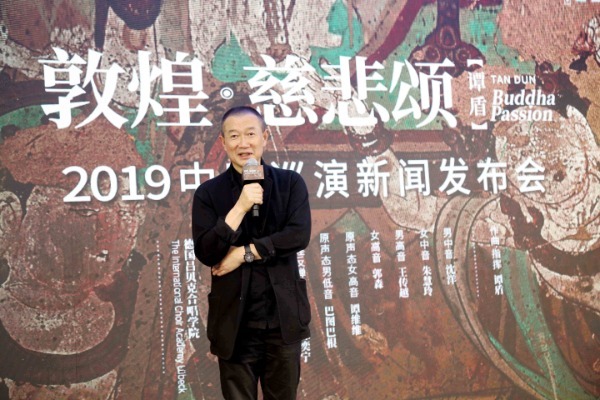
During the last six years, Academy Award-winning composer Tan Dun has traveled to the ancient city of Dunhuang, Northwest China's Gansu province, multiple times to study and document the Mogao Caves.
A UNESCO World Heritage site, the caves have a large number of murals, which date back to the 4th and 14th centuries.
The result of his visits is a large-scale work, entitled Buddha Passion, which Tan composed for soloists, chorus and orchestra.
After a world premiere at the Dresden Music Festival in Germany on May 23, 2018, and an Asian premiere at the Hong Kong Cultural Centre in November, Buddha Passion will embark on its first tour of the Chinese mainland from June 9 to 22, visiting Xi'an in Shaanxi province, Dunhuang, Changsha in Hunan province, Qingdao in Shandong province, Shanghai and Beijing.
The Orchestre National de Lyon and the International Choir Academy Lubeck will perform the piece under the baton of Tan, along with seven Chinese soloists, including tenor Shen Yang, soprano Guo Sen, singer Tan Weiwei and singer Batbagen, an ethnic Mongolian who also plays morin khuur (the traditional Mongolian horse-head fiddle) and is a master of khoomei (throat-singing).
"This is the most important work of my life," said Tan, 62, in Beijing, following the announcement of the Buddha Passion China tour on Friday.
"The stories told through the murals have been passed down for thousands of years, which inspired me. They contain the universal concepts about love, forgiveness, sacrifice and salvation," Tan says. "The paintings, which portray music, ancient musical instruments and big bands, impressed me the most. I wondered about the sounds of Dunhuang, or even ancient China of more than 1,000 years ago."
The composer went to museums and libraries around the world, such as the National Museum of China, the British Library and the National Library of France, to learn about ancient Chinese musical instruments and manuscripts.
He also tried to replicate instruments, especially the pipa (a four-stringed Chinese lute), images of which are found on the cave walls, with the help of luthiers and experienced instrument craftsmen.




















