



Nation's flower power in full bloom









Online businesses offer reasonable prices, consistent quality
Every Monday morning at 9:30, a fresh bouquet arrives in Wu Minhui's office in Zhujiang New Town, the central business district of Guangzhou, capital of Guangdong province.
In the first week of last month, the bouquet contained three red roses, five pink carnations and a eucalyptus leaf, all wrapped in strong brown paper.
But the bouquet was no romantic surprise from a boyfriend, it was "self-love", Wu said.
The 27-year-old thinks women should spend money to please themselves instead of other people.
"I buy flowers for myself because it not only makes me feel cherished, but I can also become more patient by taking care of them," she said.
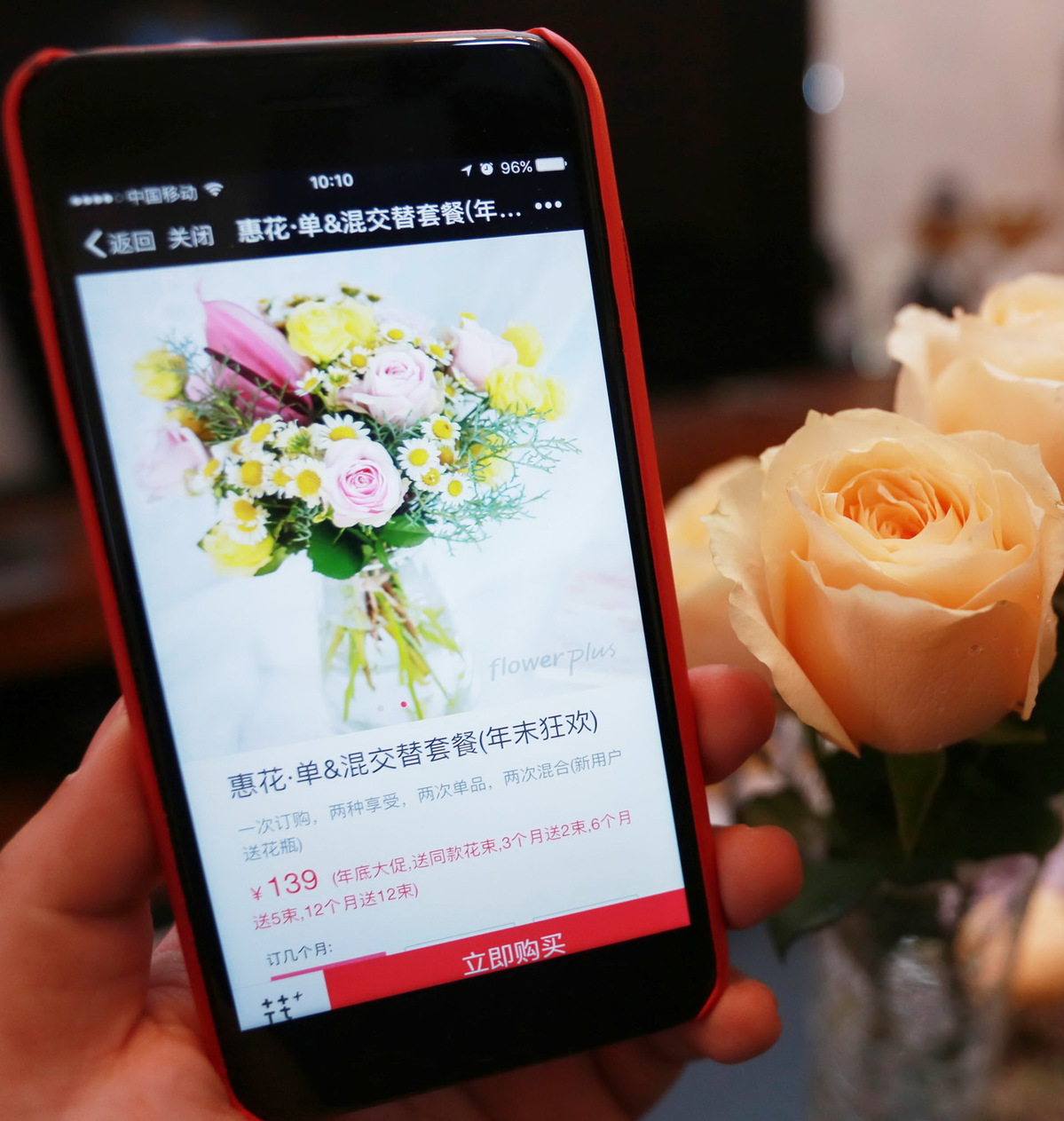
Wu, who subscribes to a weekly delivery service provided by Flowerplus, an e-commerce startup, said buying blooms has also become a habit for many of her colleagues in the fund company she works for, especially young women.
Online florists such as Flowerplus and Reflower have introduced subscription services in recent years, which have made blooms more affordable and buying them a habit.
With just a few taps on their smartphones, and payment made through WeChat or Alipay, Wu and her colleagues can have fresh, custom-ordered bouquets delivered to their office every week.
"The best part is that the price is reasonable and the quality is consistent. I get my Flowerplus packages for as low as 20 yuan ($2.90) a week for a basic bouquet," Wu said.
"When I first ordered flowers online, I didn't expect it to turn into a habit."
In Wu's office, the working day often starts with her putting the flowers in a vase, placing it on a table and then making a cup of coffee.
China's booming e-commerce and online-to-offline services have accelerated flower buying significantly, with many people regularly making purchases.
But this is a relatively new trend compared with the country's centuries-long tradition of floral culture.
More than 1,000 years ago, people in the Tang Dynasty (618-907) went on outings to admire flowers. They would cut down some tree branches in full blossom and take them home to use as decorations.
Now, once again, Chinese are showing their floral appreciation.
Internet consulting company iResearch estimates the country's cut-flower e-commerce market expanded from 1.2 billion yuan in 2013 to 12.4 billion yuan in 2017 and is likely to reach nearly 50 billion yuan by 2021.
A large part of this growth is due to the middle class, who are increasingly viewing cut flowers as part of daily life, rather than luxuries for special occasions.
A report this year by Tmall, Alibaba's e-commerce platform, said consumers, especially women, are buying more items for themselves than they have in the past, especially young women.
Tmall's data show that women's consumption of flowers, books, tourism, wire-free bras, flat shoes and other so-called treat-yourself products is continuing to grow significantly.
Mao Haipeng, from the Yunnan Dounan Flower Industry Group, said, "This is part of a natural shift as China's economy has developed and families have started to have more disposable income for items that may have been seen as wasteful in the past."
While some households still grow blooms at home, more are switching to buying cut flowers for their freshness and variety, Mao said.
"Flowers are becoming a necessity for Chinese families," he added.
Mao's group runs the international flower trading market in Dounan county, Yunnan province. In just three decades, the town has expanded from a rural backwater to become Asia's biggest flower market, supplying more than 75 percent of China's cut blooms and exporting flowers throughout the region.
"Demand has been so great that there are now about 300,000 farmers cultivating 1.5 million hectares of flowers in the province, up from just a few dozen growers and less than 10,000 hectares back in the 1990s," Mao said.











