



Japan's break with tradition doesn't really change anything: China Daily editorial









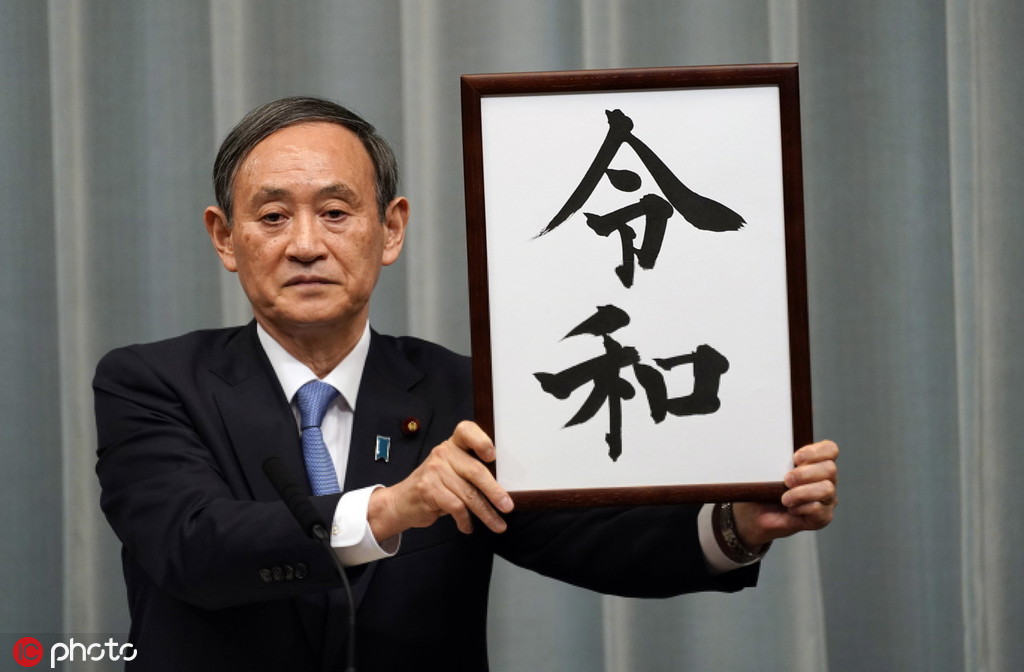
It remains a name comprising two Chinese characters conveying auspicious meanings. And it sustains the perpetual hope for blessings. Despite the absence of a precise, official English translation, Reiwa, the name the Japanese government has given to the next imperial era beginning May 1, is as traditional as it could be.
Except that it was chosen by the Shinzo Abe Cabinet from a poem in the Japanese literary classic Manyoshu, which was compiled sometime after 759.
That the naming process has been reported as breaking the 1,300-year tradition of choosing characters from ancient Chinese literary classics has prompted alarmist calls for "vigilance" against what some see as Abe's "de-Sinicizing" of Japanese culture. Yet, as some scholars in this country have pointed out, the two characters appear in almost identical sentences in a piece by Chinese writer Zhang Heng, almost 700 years before the Japanese poem the characters are taken from.
Given their leanings, it is not worth making a fuss over Abe and his colleagues wanting to highlight a more Japanese identity, although some Chinese may feel slighted that the tradition of naming a new imperial era by drawing inspiration from Chinese literature has been broken.
If it was indeed intended as a de-Sinicizing move, then that goal is far from being realized, as Japan would have to find a way to banish Chinese characters altogether to accomplish it. After all, despite their "Japanese" origin, the two characters are still Chinese, not only in form, but in connotations.
The truth is, the Chinese and Japanese cultures have become so profoundly interwoven with each other through the course of history that it is nearly meaningless, if not impossible, to draw a clear line between them in every area.
There may be various considerations behind such a name. But what matters in the two countries' relations always boils down to what they actually do.
It would be wrong to read too much into the break with tradition in the naming of the new era and view it as a change of approach by the Abe administration.
Abe's desire to rid Japan of the postwar system so the country can assume the mantle of a major power — a process that has been accelerated by incumbent US administration being less accommodating of Japan's concerns than its predecessor — has resulted in him seeking to improve relations with China, and he has worked hard to reach a consensus with China on win-win economic and trade cooperation.
Although finding a name for the coming imperial era from his own country's historical literature is very much in line with Abe's feelings about China, he is not going to throw that consensus away now.
Indeed, the characters chosen for the new imperial era imply auspicious harmony, and that is certainly something worth giving attention to.





