



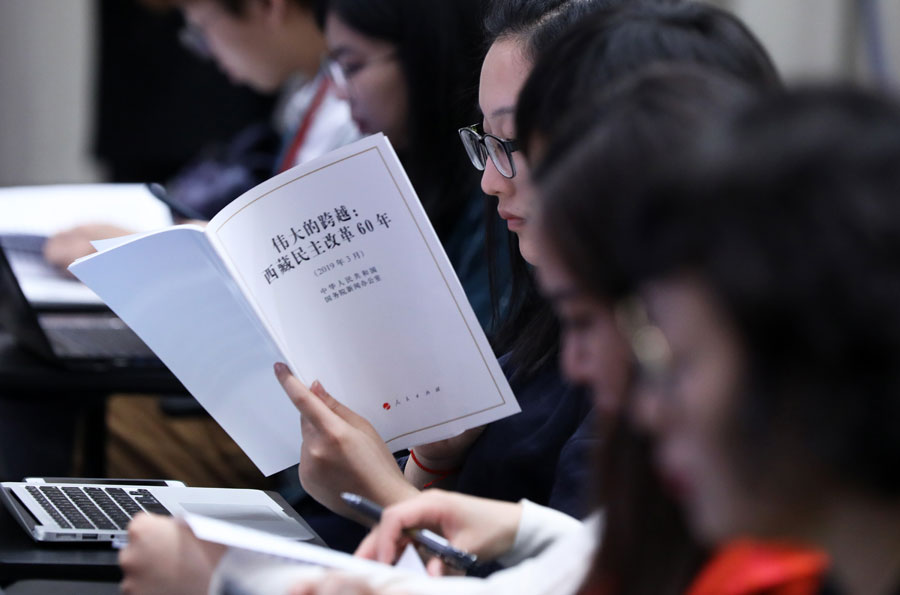
China issues white paper on democratic reform, achievements in Tibet









MODERNITY AND PROSPERITY
In 2018, Tibet's GDP was 147.76 billion yuan ($22 billion), soaring from the 1959 figure of 174 million yuan.
Before democratic reform the serfs had little food and scanty clothing; immediately after democratic reform began, their living conditions started to improve. In 2018, the average per capita disposal income of urban residents was 33,797 yuan, and that of rural residents was 11,450 yuan.
In old Tibet, education was largely the preserve of the privileged aristocracy. The serfs who made up 95 percent of the population were not entitled to education, resulting in an illiteracy rate surpassing 95 percent among young people.
In 2018, the net enrollment rate in primary schools in Tibet was 99.5 percent, while gross enrollment rates in junior high, senior high and higher education were 99.5, 82.3 and 39.2 percent, respectively, with the per capita length of education reaching 9.55 years in the region.
FREEDOM OF RELIGION
"After democratic reform, Tibet put an end to theocracy, separating government from religion and so restoring the latter's true significance," the document said.
Currently, Tibet has 1,787 sites for the practice of Tibetan Buddhism, over 46,000 resident monks and nuns, and 358 Living Buddhas. There are four mosques and over 12,000 native Muslims, and one Catholic church and 700 believers.
The Living Buddha reincarnation is a succession system unique to Tibetan Buddhism, and is respected by the state and governments at different levels of the autonomous region.
By 2018, 91 incarnated Living Buddhas had been confirmed through traditional religious rituals and historical conventions.
Since the 1980s more than 1.4 billion yuan has been spent on restoring Tibetan cultural relics and refurbishing key monasteries.


- Zhejiang to focus on innovation, role as 'strategic pivot'
- Revision to Prison Law helps protect inmate rights, improve rehabilitation
- Book acts as window on China's governance philosophy
- President sends festive greetings to working people
- Exertion, sweat give students 'real rewards'
- Hands-on experience instills steel, empathy in students





