



Premier Li meets the press: Full transcript of questions and answers









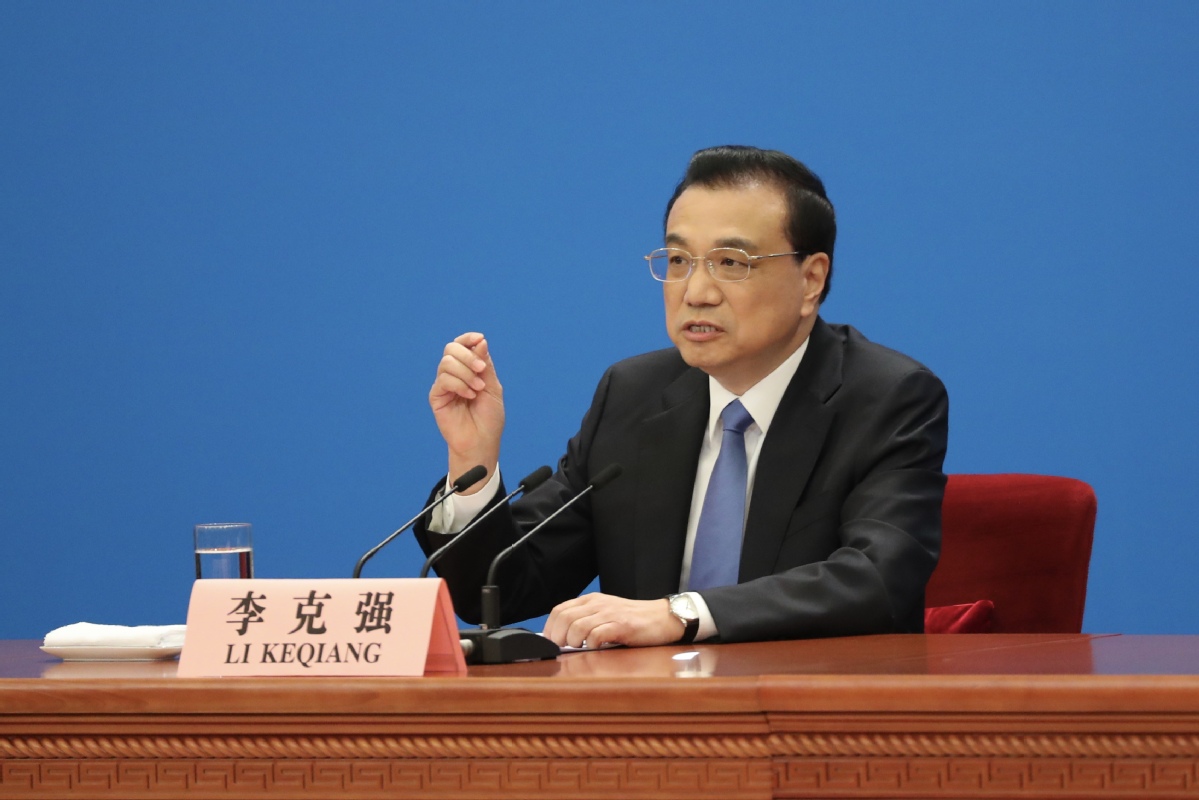
The Second Session of the 13th National People's Congress held a press conference at the Great Hall of the People on March 15, 2019. Premier Li Keqiang met with Chinese and foreign reporters and answered their questions at the invitation of Spokesperson Mr Zhang Yesui.
Reuters: Last year China took a number of measures to ease monetary conditions. China also cut taxes and fees. This year China is promising more monetary easing, more tax cuts and more infrastructure spending. Are China's economic problems bigger than previously thought? And if the economic slowdown doesn't stop, would China consider taking more aggressive measures such as lifting property curbs and cutting benchmark interest rates?
Premier Li: You went straight to the point in your question and I will not beat about the bush. It is true that China's economy has encountered new downward pressure against a larger backdrop of slower global economic growth. In the past month or so, several major international organizations have adjusted downward their forecast for global growth this year. We have adjusted downward, as appropriate, our projected economic growth target for 2019, and set it at a target range. This is compatible with the GDP growth rate we achieved last year. It is also consistent with our determination to prevent major economic indicators from sliding out of the proper range. By this way, we have sent a message of stability to the market.
Last year, under the strong leadership of the CPC Central Committee with Comrade Xi Jinping at its core and guided by Xi Jinping Thought on Socialism with Chinese Characteristics for a New Era, people across China made united efforts to advance the supply-side structural reforms, and we achieved a 6.6 percent GDP growth, which was no mean feat. Against the backdrop of growing trade protectionism in the international environment, China's GDP aggregate reached 90 trillion yuan. Our projected target for GDP growth this year is 6-6.5 percent. It will be a growth on top of a very large base figure. Keeping steady growth of China's economy in itself is important progress.
We must take strong measures to cope with the current downward economic pressure. One possible option is to resort to quantitative easing, including excessive money supply and a much higher deficit-to-GDP ratio, flooding the economy with liquidity. Such an indiscriminate and expedient approach might work in the short run, but may also lead to future problems. Hence, it is not a viable option. Our choice is to energize market players to counter the downward pressure. We encountered economic downturn in the past several years, and the measures we took were aimed at boosting the vitality of the market, which generated stronger dynamism for development.
China now has over 100 million market entities. When their vitality is fully unleashed, the energies that could be created would be incalculable. We must keep our policies stable and ensure their continuity. We will continue to cut taxes and fees, streamline administration, foster new drivers of growth, broaden market access and level the playing field for all market players. In this way, we will be able to lift the curbs on the market, free up space for companies and resolve concerns for our people. We will generate tremendous creativity in this process. And this will also put us in a strong position to keep major economic indicators within a proper range and achieve high-quality development.
We also need to take strong measures to cope with growing uncertainties that we face this year. We have policies in reserve for that purpose. For example, we raised the deficit ratio for this year by 0.2 percentage point to 2.8 percent, which is below the international warning line of 3 percent. In addition, we can also resort to quantitative or pricing tools like required reserve ratios and interest rates. We are not going for monetary easing, but trying to provide effective support to the real economy. Facing new circumstances, we will stay firmly grounded in China's realities and take a long-term view. We will do our best to keep China's economic growth stable and maintain the sound momentum of the economic development for the long run. China's economy will remain an anchor of stability for the global economy.














