Beware, news anchors, AI is coming










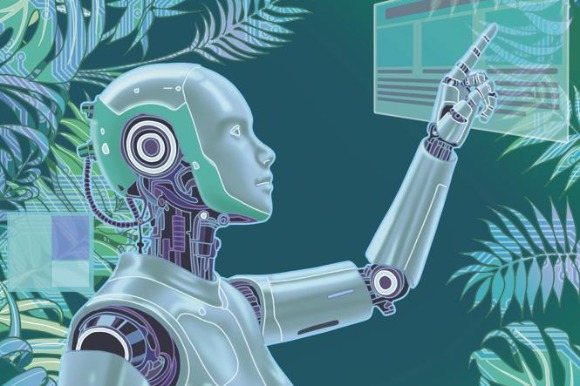
News anchors must have been rather reluctant to read out the following news: Xin Xiaomeng began working as the world's first female artificial intelligence news anchor at Xinhua News Agency on Sunday, three months after a male robot joined the profession.
In fact, Xin has been broadcasting news about the ongoing two sessions just like her human colleagues do.
Some video clips show how Xin works. All Xinhua needs to do is to feed the English and Chinese texts into the receiver for her to read them like a normal news anchor.
Unlike previous androids though, Xin does not read news like a cold machine; she reads it almost like a human being. The muscles on her face stretch and relax-and her reactions change-as she continues reading.
That's why on Sunday night, the "Moments" of news anchors and journalists was full of one question: Will AI replace us in the near future?
To find the answer to the question, we have to analyze the technologies that support Xin at her job. According to Yang Feng, an associate professor of AI studies at Northwestern Polytechnical University in Xi'an, Shaanxi province, three key technologies are used to support Xin.
First, samples of human voices are collected and synthesized. This is followed by the collection and synthesis of human muscle movement samples. And third, the voices and movements are married in a way that when the AI news anchor reads, the micro-electric motors behind her face move to make her expressions seem human.
Yet we need a thorough theoretical and practical knowledge of deep learning technology, an essential part of AI technology, to make a robot imitate a person's voice. The developer needs to collect tens of thousands of pieces of pronunciations, input them into the machine and match them with the text for the AI to learn and read. For accurate pronunciation, he has to break every word into single-phonetic elements for the AI news anchor to learn and read.
The process for imitating facial movements is similar. The developer has to analyze the movements of the 53 muscles in the human face, make a model set from the collected data for the AI news anchor to learn, and imitate the movements of facial muscles via programs.
Both the technologies used to make Xin's performance impressive are mature.
The real difficulty lies in the third-the technology to match the pronunciations with facial movements so that Xin's expressions vary according to the content of the news report.
The process is very difficult because too many conditions are involved. For example, a "box" can refer to the black box of an airplane that has crashed, or a box of chocolates gifted to a dear one on Valentine's Day. So when the AI news anchor pronounces a word, its processor must judge from the context whether it carries a good or bad meaning, and how good or bad it is. As for the electric motors, they can be designed and programmed to respond to the configurations and generate the needed "emotions" on the face of the AI news anchor.
But this technology is far from being mature, at least not mature enough to help robots replace humans as news anchors. In fact, Xin's expressions don't always change according to the content. As a result, her expressions look anything but human.
Actually, AI is still no match for human qualities. For example, how can a robot interview a real human being? It is also too early for robots to analyze a given situation or problem, and remark or react accordingly.
News anchors therefore should relax, at least for now, that robots are not going to replace them. But news anchors, rather all journalists, should sharpen their skills and develop innovative traits to counter the job threat robots could pose in the future.
The author is a writer with China Daily. zhangzhouxiang@chinadaily.com.cn