



As e-commerce blossoms, flower business takes root









Internet creates new entrepreneurs, including people in poor rural areas
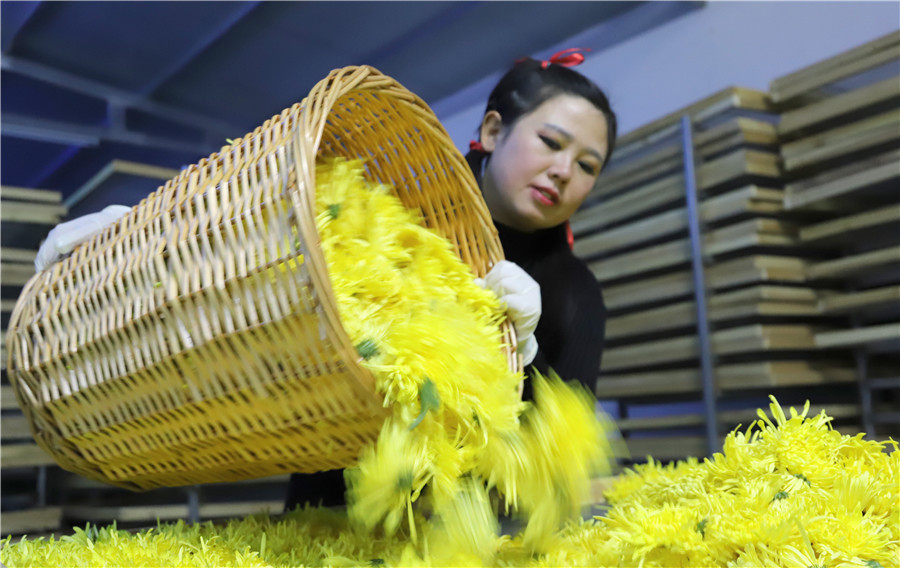
As the chrysanthemums blossom, so does Liu Youjuan's business-an undertaking whose seeds had not even been planted four years ago.
The soil in which those seeds eventually found root was e-commerce. In the past few years it has turned millions of Chinese who previously lacked business experience into successful entrepreneurs.
Liu, 39, has been growing and selling golden chrysanthemums in Fugang village of Tiemengang township in Macheng since 2015. Two years ago she struck pay dirt by selling golden chrysanthemum tea online.
"E-commerce is an incredibly cost-effective way of running a business," Liu said. "It has increased my income by enabling me to sell chrysanthemum products nationwide with little travel."
Millions of other e-commerce businesses throughout China are reaping the rewards of a model that links buyers and sellers directly, with billions of transactions and oceans of money each year.
It's part of the central government's innovation-centered strategy to eradicate poverty, and one that encourages poor families to help pull themselves out of poverty by using the latest technology.
The plan is paying huge dividends, not only improving the lives of millions of Chinese, but also helping to revitalize rural areas.
Liu was a migrant worker before quitting her job and returning to her hometown to take care of her ailing parents-in-law in 2015, a shift that left her with no income. About the time of her move she resolved to pull herself out of poverty by growing golden chrysanthemums in the village.
Her flower fields expanded to 4 hectares in 2016, and she developed a modest customer base. But she felt that she needed more. It was then that she enlisted the help of the local government.
"Government officials said that if I was interested in selling my flowers online they would give me the necessary training," Liu said.
To help set up the business, she obtained a loan of 50,000 yuan ($7,400) in September 2017.
Liu created her own brand of products made with flowers and set up online stores on Taobao and WeChat, as well as on a local e-commerce platform. She now provides products to four other online stores and plans to open a store on the social e-commerce platform Pinduoduo in April.
Her chrysanthemum products can now be found in homes and workplaces across the country.
Liu eventually shifted her focus from trading dry flowers to selling golden chrysanthemum tea.
"After two years exploring e-business, I understood how to improve products, and selling processed products increased the value of the flowers," she said.
Liu now has 20 hectares of chrysanthemum fields in Fugang and said sales exceeded 2 million yuan last year, with 80 percent online. Her growing income allowed her to buy a new house with an adjoining factory.
Knowing that others in her village were less fortunate, Liu provided jobs. She said she now has people from 15 poor households working for her, and each household earns additional income of 4,000 to 5,000 yuan annually.
"I was part of the impoverished group, and most of my employees are the elderly who were left behind in rural areas. So I feel it is my duty to help them," she said.
Xia Xigui, who has worked for Liu for two years, said she can earn more than 10,000 yuan a year.
"Liu is very capable, and her way of doing business is a very creative approach in rural areas," Xia said.
By the end of next year, China aims to have completed lifting 55 million rural people out of poverty and to have given half the country's poor villages the wherewithal to use e-commerce.
Macheng was listed as a national rural e-commerce pilot county in 2015. The local government has adopted policies promoting the new form of business, and continues to explore ways to reduce poverty through e-business.
It has built 414 e-commerce service stations in the 452 villages in the city, 159 of them in poor villages serving 6,335 impoverished households.
Officials said the city has provided e-commerce training for 16,000 people.
"The major task is to extend e-commerce thinking and consumption habits to rural areas and change the way they look at business," said Liu Hongli, director of the e-commerce office in Macheng.











