


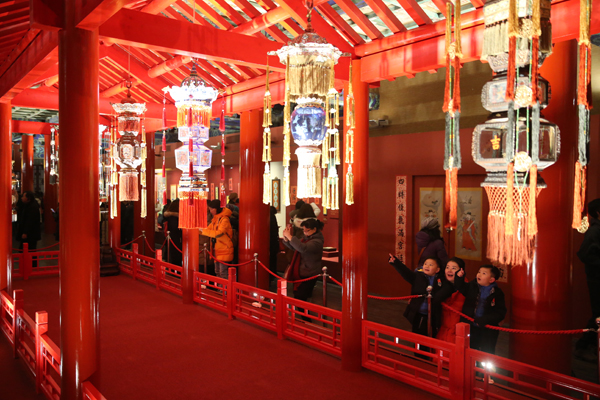
Giving thanks
Chinese people are grateful in happy moments. So were the emperors.
During Spring Festival, families all over the country present offerings and sacrifices to their ancestors in solemn ceremonies to remember the virtues of departed loved ones and to promote filial piety.
The ceremonial tablets of the Qing emperors-and pendants, which were used to remind rulers to remain abstinent during preparations for the ceremonies-are showcased at the exhibition. They also stand as testaments to top-tier craftsmanship.
Emperors would write auspicious messages to invoke blessings for their dominion. In dynastic times, these messages were sealed in yellow boxes, which were never intended to be reopened but are now available for public viewing as part of the exhibition.
Qing emperors could not really forget about state affairs during Spring Festival, though the royal court held an annual ceremony to put away the imperial seals, indicating a period of repose.
The precious Gold Chalice of Eternal Stability-an iconic artifact inlaid with gemstones, embodying the expectation of stability and prosperity for the country-was put on emperor Qianlong's desk, reminding him to remain diligent.
Qianlong's study was part of the Hall of Mental Cultivation. As the hall is currently under renovation, his "home office" is duplicated for the exhibition, of which, the gold chalice is a highlight.
Being heavily protected by high palatial walls, emperors sometimes also organized Lunar New Year's fairs within the Forbidden City to better know how their humbler subjects spent their holidays.
However, the "vendors" were actually actors.
Once again, one of the Palace courtyards will fill with the sights, sounds and smells of a New Year's fair, but this time the vendors are genuine.
More than 150 time-honored brands from around the country, most of which are purveyors of New Year's snacks, will hawk their wares within the walls of the Forbidden City. The fair is set to run through Feb 10.
For visitors to the museum, there is not only a feast of knowledge and spirituality but also the joy of treats for the tummy.
Lamps for revitalization
Since the Ming Dynasty (1368-1644), emperors would order the erection of "sky lamps"-which were more than 10 meters high-as well as slightly shorter "longevity lamps" in front of the Palace of Heavenly Purity, a key building within the Forbidden City, to ask for best wishes for Lunar New Year.
The lamps, with their exquisite decorations, were highly detailed and difficult to make, requiring state-of-the-art craftsmanship.
During the reign of Qianlong, the tradition was expanded to many other palaces. Historical records show it took about 8,000 people to make and install the lamps.
Qianlong died in 1799, and the end of the 18th century beckoned the decline of the Qing Dynasty.
Facing a shrinking national treasury, the thrifty emperor Daoguang decided to stop the tradition of the lamps in 1840.
The same year, war broke out between Chinese and British forces. The Qing lost the war, and Hong Kong was ceded to the United Kingdom. It marked the beginning of a dark period for China, punctuated by war and social upheaval.
As for the abandoned stone foundations in front of the Palace of Heavenly Purity, few people still remember what they were used for.
However, museum authorities have decided to once again erect the lamps this year. During months of preparation, Ren led a team to uncover the design blueprints of the lamps by referring to old files of the imperial court. They also gather scattered information about the lamps from home and abroad.
In September, the team produced the final draft, but Ren admits that time was against them to find identical materials to those used in the old days-such as the huge and precious lumber-to erect the lamps before Lunar New Year. Instead, copper was used for the poles.
After disappearing for 179 years, last week, the lamps stood once again, albeit unlit-after all, there is still a curfew in the Forbidden City and no visitor is allowed to stay there after night falls.
Ren still sees them as symbol of the country's modern revitalization that lights a path from the past to a bright future.





