



A foreigner's perspective on Chinese creativity and innovation










Since 2013, Chinese innovation has increased steadily.
According to the global innovation index (published by Cornell University, INSEAD, and the World Intellectual Property Organization in partnership with other organisations and institutions) for 2018, China has now entered the top 20 most innovative countries in the world, ranking 17th.
Although Chinese creativity is different from that in the West, progress in innovation is constant.
There are some key elements which have fostered the consistent progress of creativity and innovation and will also transform China into a world leader in science and technology by 2030.
Chinese creativity
The concept of creativity in Chinese culture is different from the West.
Puccio and Chimento have stated that Chinese creativity is based on progressive improvement, modification and adaptation. Thus, Chinese creativity is often focused on perfecting an existing idea and gradually improving it.
On the other hand, producing novel ideas and products that are valuable and unique is considered creative in Western culture. Therefore, the evaluation of Chinese creativity from a Western viewpoint may lead to misunderstandings.
However, Chinese creative practices shine in their own way and positively contribute to the world.
Innovative and creative society
China has now become an innovative society.
In 2006, Chinese leaders took a plan to transform China into an innovative society by 2020 as their medium- to long-term plan for the development of science and technology.
This aim has nearly been achieved in light of the 2018 global innovation index (published by Cornell University, INSEAD, and the World Intellectual Property Organization in partnership with other organisations and institutions) that ranks China in 17th place, compared to Canada at 18th, Norway at 19th, and Australia at 20th.
China's significant improvement has emerged in publications, R&D expenditures and online creativity. This is a noteworthy breakthrough of Chinese initiatives to make China an innovative society.
Fostering PhDs and science graduates
PhD holders and science and technology graduates are key factors for creativity and innovation.
China is the second-highest producer of PhDs in the world after the US. The number of PhD students graduated in 2017 reached 79,738 for the US, 34,400 for India, roughly 30,000 for Germany, and 23,650 for the UK.
According to a report from the Chinese Ministry of Education, 58,058 PhD students graduated in the same year in China, which supports the country's second-place ranking behind the US.
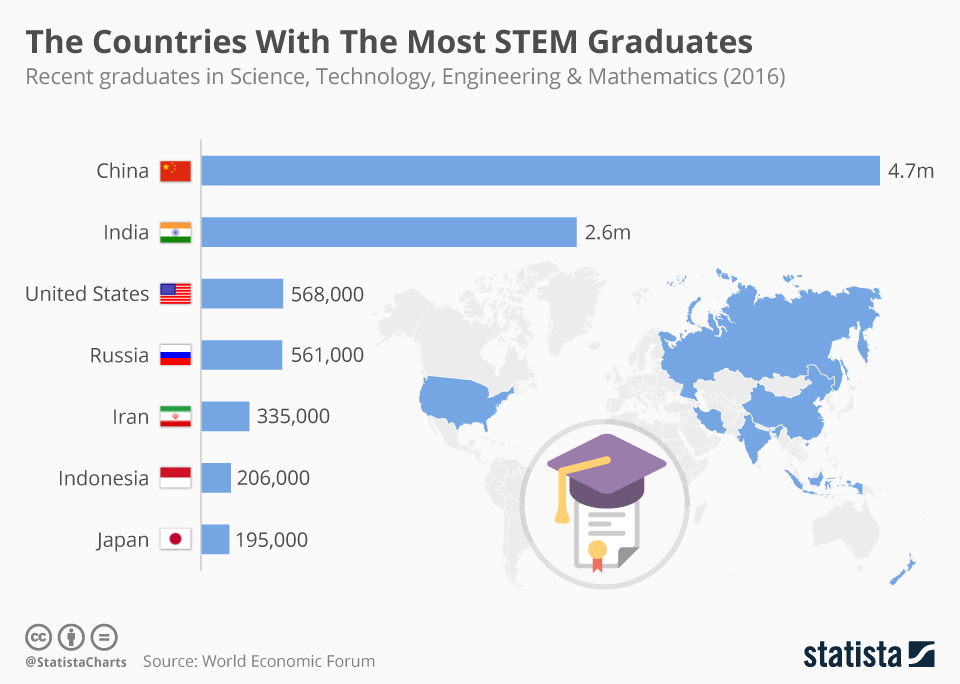
Moreover, China produces the most graduates in the world in the fields of STEM, or science, technology, engineering and mathematics.
The World Economic Forum report noted that China produced 4.7 million STEM graduates in 2016, whereas India produced 2.6 million and the US produced 568,000. These achievements significantly influence scientific contributions, making China a more creative society.
University global rankings
University global rankings are a key to quality education as well as a good indicator of creative innovation. Chinese institutions now rank among the world's top 50 universities.
According to the Times Higher Education World University Rankings for 2019, Tsinghua University is the top institution in Asia and 22nd in the world rankings.
The teaching environment at this university is ripe for creativity and innovation, and its advancement is reflected in comments from Oxford University Professor Simon Marginson in response to the rankings: "Tsinghua University is the No 1 university in the world for highly cited research in science and mathematics."
In addition, according to the rankings, Peking University secured a place among the top 50 universities in the world and the University of Science and Technology of China ranks among the top 100 world-leading universities.
Moreover, Times Higher Education included a total of 72 Chinese universities in the world rankings.
These factors all demonstrate that in science and technology, Chinese universities have a quality education system on par with worldwide standards, fueling recent innovation.
China's recent innovation
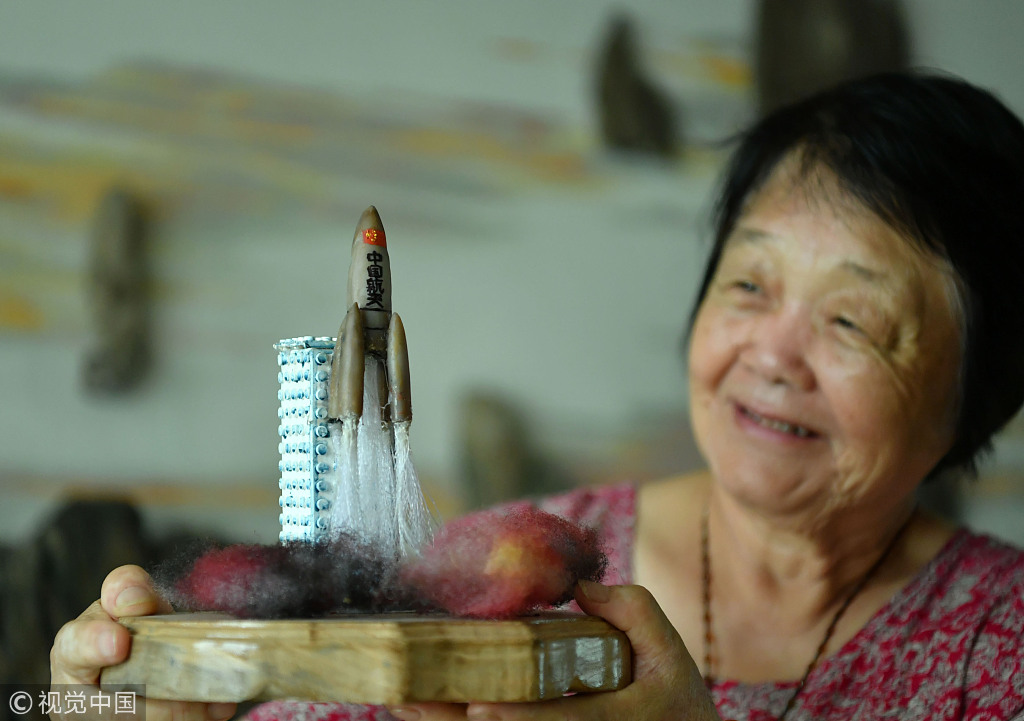
Recent innovations in China have captured the attention of the world, as Chinese scientists have made significant scientific contributions.
These include the world's first quantum-enabled satellite (Micus), the world's fastest supercomputer, the world's largest and fastest radio telescope, the world's first solar-powered expressway, the world's largest floating solar power plant, and the world's thinnest keyboard.
In addition, besides landing on moon, China is going to launch the Chengdu "artificial moon" and the world's biggest waste-to-energy plant next year.
These accomplishments, along with Hangzhou's 5G technology-based innovation park, will add more value to Chinese innovation.
In sum, China's own creative practices, recent achievements as an innovative society, good university rankings, and number of research scholars have helped realize the Chinese dream through innovation.
No matter how much the country's creativity may differ from the West, China will lead the world as a global leader in science and technology by 2030.
The author is a doctoral fellow at the School of Psychology at Central China Normal University.





