



Deeper reform will make replicas history









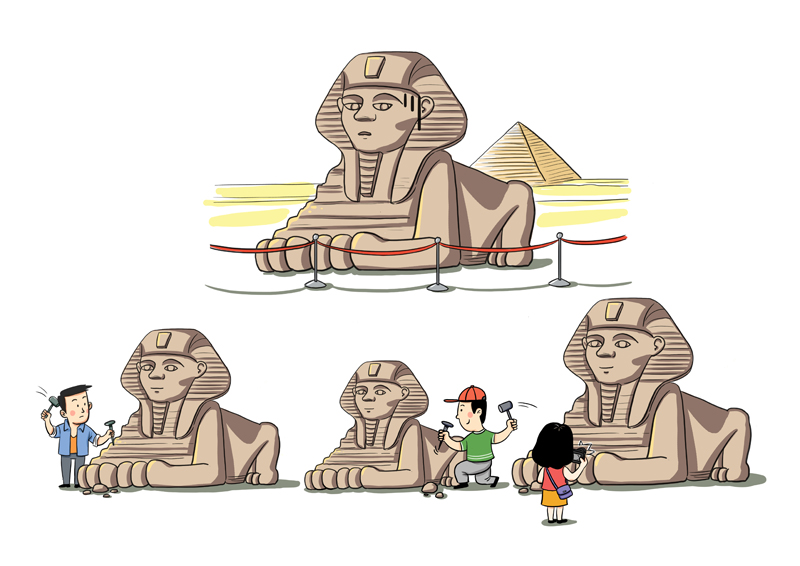
A one-to-one replica of Sphinx, an Egyptian cultural heritage structure, in Shijiazhuang, capital of Northern China's Hebei province, was demolished recently after Egypt sought to file a second complaint against the structure with the United Nations Educational, Scientific and Cultural Organization.
The replica in a film and television park was meant to help filming but it was built in 2014 without the authorization of Egypt. After Cairo filed a complaint with UNESCO in 2014 saying the park had breached world cultural heritage rules, the park owners separated the head from the body of the structure in 2016 to show they had dismantled it. But when the park secretly re-assembled the structure, Egypt sought to lodge a second complaint with UNESCO.
This time, the park has said the Sphinx replica will be modified into a fountain with a deer's head and a lion's body.
Gaining popularity in the 1990s, parks displaying replicas of world cultural heritage structures became quite common in China with the most famous being Windows of the World in Shenzhen, a theme park which has replicas of about 130 sites from five continents, including the Eiffel Tower of France, Sydney Opera House of Australia, Pyramids of Egypt, and the Grand Canyon of the United States.
Similarly, by making "the world is wonderful" its theme, Zhengda Variety Show that premiered on China Central Television in 1990 became a big hit among domestic audiences. The prime time variety show on CCTV every Sunday centered on natural wonders, scenic spots, historical sites, and customs around the world.
Moreover, TV series such as A Native of Beijing in New York, which focus on the daily life of Chinese overseas, are also popular nationwide.
Such shows have one thing in common: introducing foreign culture to China to meet the new requirements of audiences necessitated by urbanization thanks to reform and opening-up.
Given the high rate of poverty in China at the beginning of reform and opening-up, people rarely got an opportunity to visit foreign countries. But since people still wanted to know as much as possible about the outside world in order to broaden their horizon, they watched TV shows and visited theme parks displaying world heritage structures such as the Window of the World.
There is little doubt these replicas have played a significant role in opening the mind of the Chinese people in the past, albeit such parks followed the rules and regulations for the display of replica structures.
But those who illegally build replica heritage structures and exploit them for business purposes should be condemned.
The constant improvement in people's livelihoods has made it increasingly easy for many people to travel overseas, which in turn has drastically reduced the importance of parks displaying foreign heritage structures.
That some such parks, even those having low-quality displays, are still doing business shows there is still a large room for improvement in the cultural tourism sector.
Cultural confidence and innovation sharpen the competitive edge of a country. People who try to make short-term profits by displaying poor copies of heritage sites without understanding the weight of history and the importance of innovation will end up losing money in the long run, because the upgrading of cultural tourism is an irreversible trend.
However, the popularity of replica structures shouldn't be ignored or made fun of given the wealth gap across China. Further reform and opening-up will help narrow the gap between the rich and the poor and replication of foreign heritage structures will become history.
The author is a researcher at the Chinese National Academy of Arts.





