



Awards show how far China has come, how far it has to go: China Daily editorial









Hybrid rice, high-speed railways, or the Chang'e 4 lunar probe which made an unprecedented landing on the far side of the moon last week are likely what first come to mind when considering China's science and technology achievements.
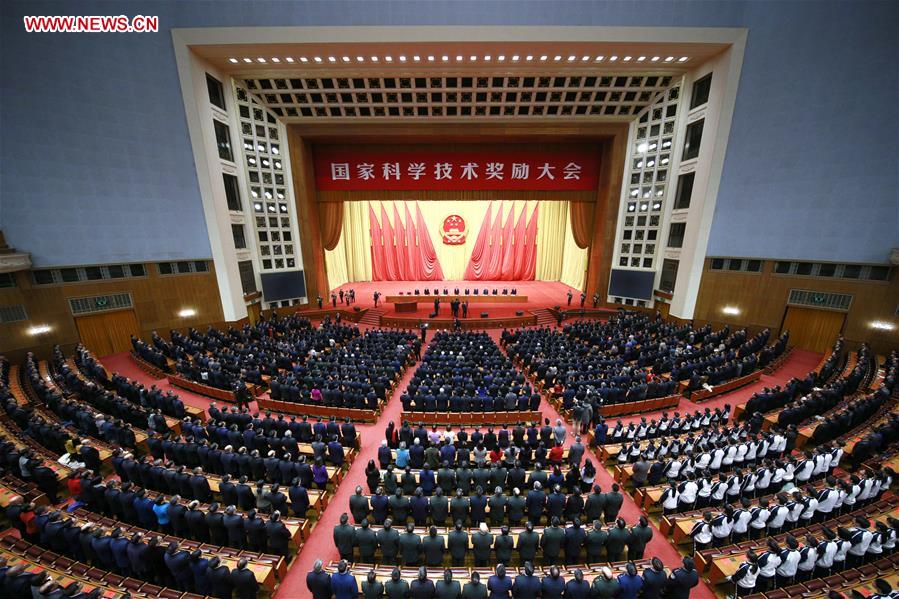
Yet the names of the scientists and engineers who are behind these scientific and engineering wonders may not necessarily be known to the public despite their distinguished contributions. Thus a grand ceremony has been held each year since 2000 in the Great Hall of the People in Beijing to honor those unsung heroes who have helped China stand tall in the world with its scientific knowledge and technology.
On Tuesday President Xi Jinping presented the top awards to two military technology experts, Liu Yongtan, for his achievements in radar technology; and Qian Qihu, for his contribution to national defense infrastructure projects. They joined the 29 elite scientists who have won the award over the previous years.
The high-profile ceremony, and the high prize given — each of the two scientists received 8 million yuan ($1.17 million), 3 million yuan more than last year — serve to recognize and encourage the hard work and innovative spirit of the hundreds of thousands of Chinese scientists who in just several decades have helped build China into a world science and technology powerhouse.
Today, China leads in the world based on many criteria for science and technology performance.
China now publishes more scientific papers than any other country apart from the United States. It ranked second as a source of international patent applications filed via World Intellectual Property Organization in 2017, again only behind the US. And China is also the second-largest spender in terms of research and development, accounting for 20 percent of the world's total R&D expenditure.
Yet this does not mean it will be a smooth path ahead for China to transform its economy into a center of innovation and become a global leader in science and innovation in the years to come.
The setback that ZTE, China's telecommunications equipment giant, suffered after a US ban on the export of US-made chips and other technologies reveals the Achilles' heel of China's quest to master some of the core technologies. Although it is the world's largest semiconductor market, China still relies heavily on imported chips needed for making high-tech products. Chinese scientists have to double their efforts to design a domestic chip if they want to turn "made in China" into "designed in China" at an early date.
And for that, the scientists have to ensure the fruits of expanded research and innovation are timely industrialized to help production upgrading, and thus propel the economy and better serve society.
Science and technology have been two of three pillars supporting the country's rapid development over the past 40 years of reform and opening-up; they still are the keys to unlock its future.





