



Smart restaurants offer high-quality experience









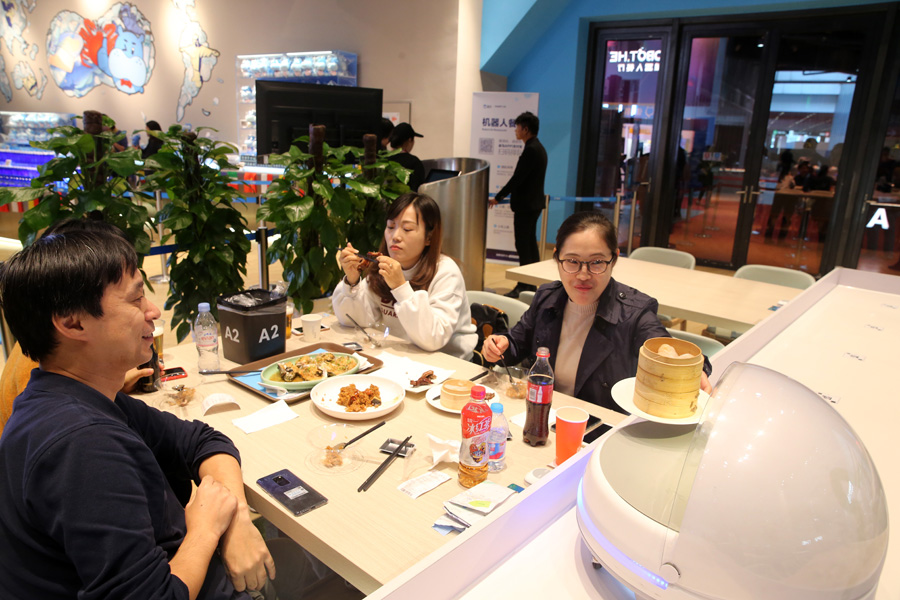
Boosted by the New Retail concept, China's catering industry is focusing on high-quality customer experiences and greater efficiency to increase revenues.
The catering industry's market scale is forecast to surpass 5 trillion yuan ($725 billion) by 2020, growing 13.6 percent from 2018, according to a report jointly released by Beijing-based think tank EO Intelligence and Koubei, Alibaba's dining and entertainment review site.
The report showed that in 2017, the nation's GDP reached 82.7 trillion yuan, and 58.8 percent was contributed by the services industry, including the catering industry. Sales revenue in the sector totaled 3.96 trillion yuan in 2017.
As the market has gradually become more saturated, different business models are engaging in fierce competition. The catering industry has marched into a medium to high-speed development stage with a 10 percent annual growth rate, boosted by technology advancement.
Market insiders predict that information technology players will invest up to 230 billion yuan into China's catering industry in the coming three to five years.
Wang Qianyun, an analyst at EO Intelligence, noted that light fast food and casual dining rose quickly. Regional trends toward developing chains, as well as the construction of central kitchens and food processing plants, are promoting supply chain reform. All these aspects are boosting the standardization of the whole catering industry, she said.
"The industry faces the problems of high labor costs, high material costs, high rent and low gross profit. Under great pressure, food enterprises are appealing for solutions to lower their costs and raise efficiency," she said.
Four major technologies are supporting upgrading in the catering industry, increasing the industry's overall efficiency.
Based on big data, the traditional restaurants' operation models are changing, in terms of finding a target audience, site selection and online marketing. Mobile payments enable online-to-offline integration in the industry, and constantly improving payment technologies are upgrading consumer experiences.
Improving delivery services are also enabling merchants to offer cutting-edge customer experiences.
Meanwhile, the upgrading of the supply chain and the use of central kitchens are changing restaurants' production processes and the way they are evolving.
Against the backdrop of the technology-driven New Retail concept, smart restaurants have emerged. Before lunch, consumers can order food at their offices, or they can make an order themselves by scanning a QR code when they arrive at the smart restaurant.
During the order process, the restaurant's electronic platform gives consumers recommendations. When the food is ready, consumers can take the dishes themselves.
The smart restaurant model-which enables self-service ordering, payment and delivery-h(huán)elps to mitigate the effects of understaffing during peak hours, meaning consumers do not have to wait in line. As a result of such innovation, restaurants' sales revenue and efficiency are on the rise.
A smart restaurant, jointly launched by Koubei and Wu Fang Zhai, achieved 40 percent growth in sales just half a year after opening. Its table turnover rate surged by 37 percent during the same period.
The restaurant has reported a 65 percent probability that customers accept its recommendations.
Besides technology advancement, as the younger generation has become a backbone of the country's consumption power, their more relaxed culture and demand for high quality food are generating new business models.
According to statistics from market researcher QuestMobile, in August, there were more than 10 mil-lion new takeout service app users under 24 years old compared to the same period last year, contributing 44 percent to the overall user growth.
Data from Beijing-based market research consultancy Analysys showed that the average per customer transaction for takeout services is constantly increasing, driven by the younger generation's demand.
Food merchants are also offering cooking services, while convenience stores are providing more and more food suitable for microwaving.
"In the future, high-quality consumption will become the priority for the catering industry, and restaurants should build their own brands to form a competitive edge. In the meantime, online-to-offline integration in the industry will deepen," said Wang from EO Intelligence.




















